Dive into Building an App
Kyle (CEO/President) and Matthew (Senior Developer) recap a webinar on building custom applications and how AI and new tools are making app development more accessible. They discuss when to bring in technical resources, common roadblocks, and how AI can accelerate developers rather than replace them. The key takeaway: start experimenting, build foundational knowledge, and know when to seek expert support.
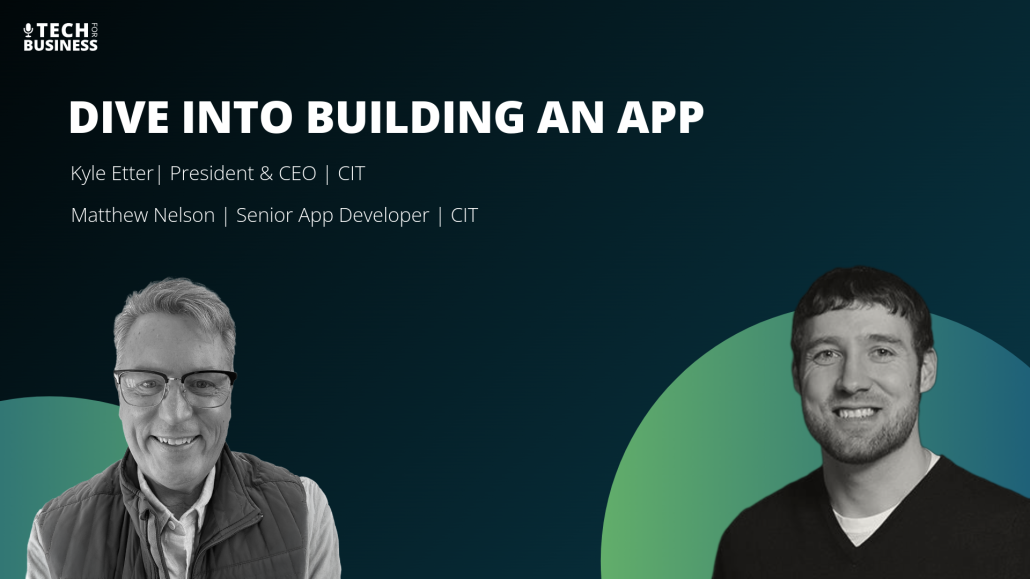
Watch the Episode
Building Your Own App?
Summary
- Building a custom app for your business used to require specialized skills and a big budget. That barrier is mostly gone now — the tools are far more available than they’ve ever been.
- There’s a real, practical line for when a do-it-yourself app needs to move to a developer: the moment it touches production data or more than one person’s workflow.
- AI hasn’t shrunk the need for developers. It’s made good ones more valuable, because now they can produce far more than they could before.
- The hardest part isn’t the technology. It’s giving yourself permission to experiment, get something wrong, and keep going anyway.
Not long ago, building a custom app for your business meant hiring a developer, writing a scope of work, and waiting. That gap between “I have an idea” and “I have a working tool” used to be wide enough to kill most ideas before they started.
It’s not anymore. Kyle Etter, CIT’s CEO and President, and Matthew Nelson, CIT’s Senior Developer, sat down after a recent webinar on building your own app to talk through what actually changed, where the guardrails still are, and why none of this makes developers less important. If you’ve ever had an idea for a tool your team needs and assumed you’d need to hire someone to build it, this one’s for you.
The Barrier to Entry Basically Disappeared
Kyle put it simply: businesses have always wanted custom applications. What’s different now is availability. The tools to actually build, test, and prove out an idea are within reach in a way they never were before — no procurement process, no six-week wait for a developer’s calendar to open up.
That doesn’t mean anything goes. It means the first step — trying something — costs almost nothing anymore. And that changes who gets to start.
So When Do You Actually Need a Developer?
Here’s the question everyone asks eventually: I built something myself. When does it need to go to someone with more experience?
Kyle’s answer is refreshingly concrete: the line is production. Before your app touches real, live company data — before it goes company-wide — that’s your moment to slow down and get it looked at. Once more than one person depends on it, once it’s quietly become part of a real workflow, it’s carrying real risk. That’s exactly when you want it validated, not after something breaks.
Matthew’s take lines up: “it’s never too early and it’s never too late” to bring in that extra set of eyes. The goal isn’t a hard rule — it’s making sure you’ve had that conversation before you touch anything live, not after.
The Learning Curve Is Real — Even If You’re the CEO
Here’s something you don’t expect to hear from a CEO with 35 years in the industry: Kyle didn’t know what a pull request was until recently. Now he’s talking about GitHub merges like it’s just part of his day.
That’s the part people underestimate. Even if AI is writing a lot of the code, you still need to understand enough of what’s happening to build something that can actually live inside a real business — not just something that works once on your laptop. Kyle’s blunt about it: that level of hands-on learning isn’t for every CEO, and it doesn’t have to be. But whoever leads this inside your company needs to be willing to pick up a genuinely new skill set, even if they never write a line of code themselves.
You’ve Got the Keys to a Ferrari
Matthew’s favorite way to describe where things stand right now: “I always look at the tools we have now as like a Ferrari.” A customer brings him a problem, and it’s like getting to drive it — turning knobs, pushing buttons, going fast. He’s quick to admit he’s a “privileged user” here — years of experience mean he already knows the moving pieces, so he’s not afraid to push harder.
That confidence shows up in the day-to-day work in a very literal way. Matthew used to spend five or ten minutes digging through a wall of error logs during troubleshooting, squinting for the one line that mattered. Now he can push that same pile of logs through AI and get the specific thing he’s looking for in seconds. Same job, same skill — just a much faster car.
Developers Aren’t Disappearing. They’re in More Demand.
There’s a narrative Kyle’s happy to shoot down: that AI means companies don’t need developers anymore. He’s watched that play out the opposite way. Companies are adding developers, and those teams are shipping far more than they used to — more updates, more applications, faster releases. Just look at how many apps have landed in the Apple and Google app stores since the tools took off: it’s exploded, because it’s suddenly a lot easier to ship something.
Good developers, armed with these tools, don’t get replaced — they get multiplied. That’s the shift. The skill still matters. It just goes a lot further now.
A Year From Now, Will Any of This Still Be True?
Asked whether the tools will look completely different a year out, Kyle didn’t hesitate: the tools will keep getting faster and more capable, sure, but the person still steering doesn’t go anywhere. Whether you’re building something just for yourself or shaping it into a real line-of-business tool, you still need someone who understands what actually needs to happen — the AI speeds up the work, it doesn’t replace the judgment.
Matthew agrees, though he’s stopped trying to predict more than a few months out — things are moving too fast for that to be useful. What he does know: it’s been fun so far, and he expects it to keep getting better for the businesses he works with.
Kyle’s take on the pace of change, after 35 years in the industry: he’s never seen anything like it. What used to take years to shift now takes weeks. “We’re all kids in a candy store,” trying out whatever tool just dropped to see what it can do.
Just Start — and Don’t Do It Alone
If there’s one piece of advice to take from all of this, it’s the simplest one: just start. Just try. That’s where everyone begins, including Matthew.
Kyle’s addition to that: don’t just send your team out to figure it out solo. Give people a real way to compare notes — a regular open meeting where the people experimenting can share what’s working, what flopped, and what they discovered, the way Matthew’s shared his own finds with the rest of the team. Learning from a peer who’s solving the same kind of problem, inside the same kind of business, is worth more than anything you’ll find searching around on your own.
Want to hear the whole conversation, including the live demo? Listen to the full webinar with Kyle Etter and Matthew Nelson here.
Enjoyed This Episode?
Subscribe to Tech for Business and get practical IT insights for SMB leaders every week. Or reach out — we’d love to hear what topics you want us to tackle next.