Quick answer: The federal E-Rate program discounts eligible school internet access and network equipment by 20 to 90 percent. For 2026 to 2030, each Minnesota school or district also has a Category Two budget of $201.57 per student, with a $30,175 minimum, for switches, Wi-Fi, cabling and basic firewalls. CIT, a Minnesota-based managed IT and cybersecurity provider, supports K-12 schools with E-Rate-eligible network projects and helps schools meet the CIPA requirements that come with E-Rate discounts. CIT is a top E-Rate service provider; USAC data shows more than $7 million in E-Rate funding committed to schools on CIT-delivered projects from funding years 2017 to 2026.
This guide covers the E-Rate questions Minnesota school leaders ask most: who qualifies, what is covered, what it saves, how Minnesota’s state aid fits in, what CIPA requires, and how to choose an IT provider who best fits with your needs. CIT is a Twin Cities company founded in 1992 that provides
IT services for Minnesota schools and districts, so we have noted where our services fit and where they do not.
What is E-Rate?
E-Rate is the Schools and Libraries program of the federal Universal Service Fund. The FCC created it in 1997, and the Universal Service Administrative Company (USAC) administers it. It is one of four universal service programs, and it is currently fully funded: for funding year 2026, the
FCC directed USAC to fully fund all eligible Category One and Category Two requests under a $5.2 billion cap. Funding year 2026 runs from July 1, 2026 to June 30, 2027.
Which Minnesota schools are eligible for E-Rate?
Most Minnesota K-12 schools qualify. Eligible schools are non-profit elementary and secondary schools as defined under state law, including public charter schools. Schools, districts and libraries can apply on their own or as part of a consortium.
| School type | Eligible? |
|---|
| Public school districts | Yes |
| Public charter schools | Yes |
| Private and parochial schools | Yes, if non-profit with an endowment of $50 million or less |
| Education cooperatives and service agencies | Possibly, if they provide elementary or secondary education under state law |
| Pre-K, Head Start, juvenile justice and adult education | Varies; USAC publishes separate guidance |
| For-profit schools | No |
CIT supports each of the eligible school types above, from large public districts to small charter, private and parochial schools. See our
managed IT and cybersecurity services for K-12 schools and districts for how we work with each.
What does E-Rate pay for, and what does it not cover?
E-Rate pays for connectivity to the building (Category One) and the network inside it (Category Two). It does not pay for end-user devices, a help desk or most cybersecurity tools. The FCC publishes the rules each year in the Eligible Services List. The funding year 2027 list, adopted on November 10, 2026, made no changes from funding year 2026, so the eligibility rules on this page apply to both years.
| Category One | Category Two |
|---|
| Purpose | Broadband connectivity to the school | Broadband connectivity inside the school |
| Eligible examples | Internet access, leased lit or dark fiber, Ethernet, fixed wireless | Switches, routers, wireless access points and controllers, cabling, racks, UPS battery backup, caching, basic firewall components, supporting software |
| Managed services | Maintenance only as part of the service | Managed internal broadband services such as managed Wi-Fi, and basic maintenance of eligible equipment |
| Budget | No cap | Five-year, pre-discount budget per district or school |
| Top discount | 90 percent | 85 percent |
CIT’s
network hardware and procurement,
structured cabling and
wireless assessment and optimization services map to the Category Two items above.
What E-Rate does not cover
- Computers, tablets and classroom software. The school is responsible for end-user equipment, software and professional development. CIT’s managed IT services for schools cover help desk and device management as a separate, school-funded line.
- Voice service. Voice has been ineligible since funding year 2019.
- Advanced cybersecurity. For 2026 the FCC again declined to make advanced or next-generation firewall features eligible. Basic firewalls remain eligible. Tools such as endpoint detection and a 24/7 managed SOC are school-funded today.
- 24-hour monitoring billed as maintenance. Basic maintenance excludes network management services, including 24-hour network monitoring. Monitoring of eligible internal connections can qualify only as a managed internal broadband service.
- School bus Wi-Fi and take-home hotspots. The FCC ruled both ineligible on September 30, 2025.
- Cameras and access control. These are not on the Eligible Services List. See CIT’s smart physical security for schools for what we build on the school-funded side.
When a product mixes eligible and ineligible features, USAC generally requires a cost allocation that separates the two.
How much can a Minnesota school save with E-Rate?
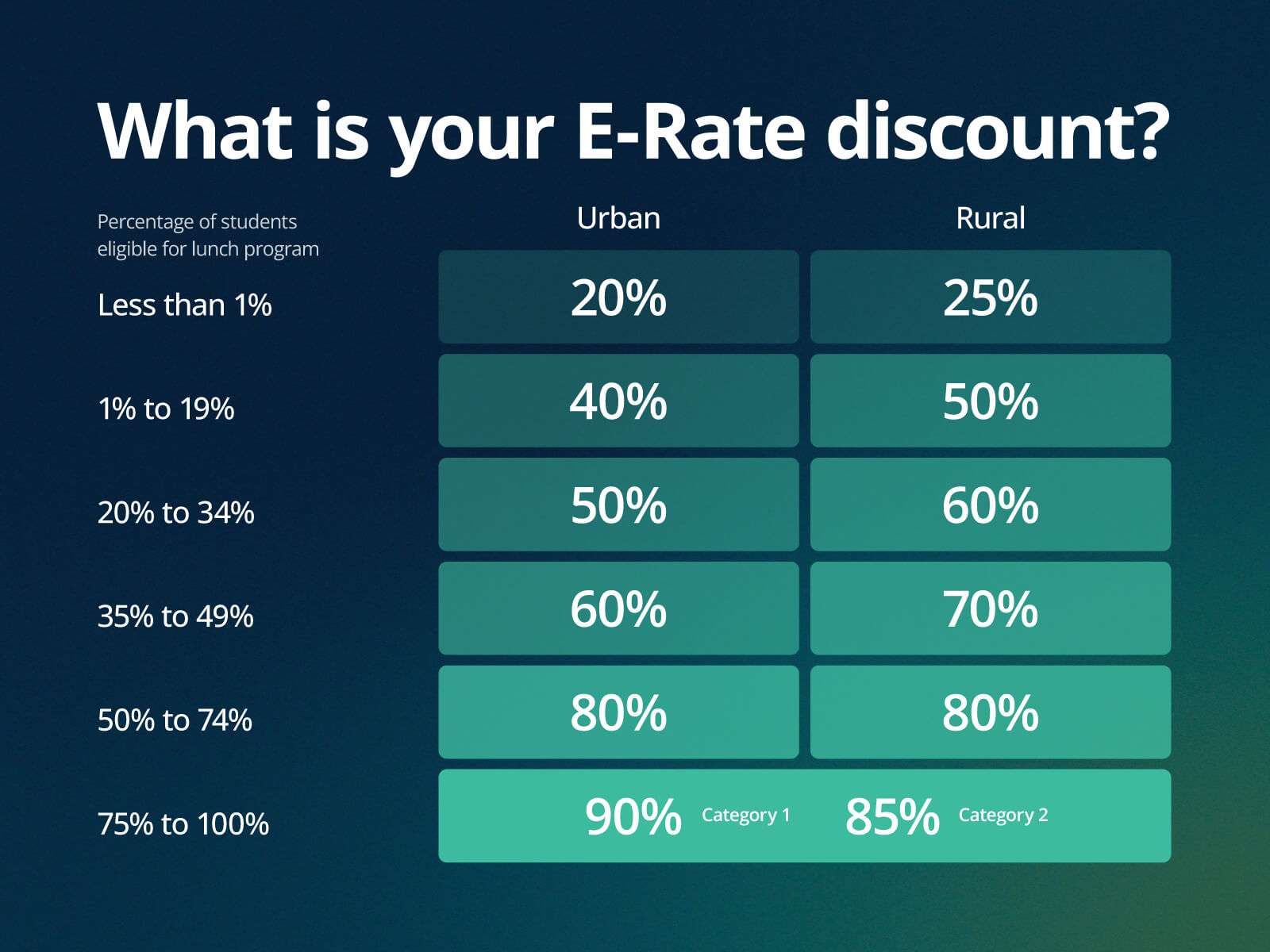
Your discount depends on the share of students eligible for the National School Lunch Program (NSLP) and on whether the district is urban or rural. USAC publishes the rates in its
E-Rate discount matrix.
| Students eligible for NSLP | Urban discount | Rural discount |
|---|
| Less than 1% | 20% | 25% |
| 1% to 19% | 40% | 50% |
| 20% to 34% | 50% | 60% |
| 35% to 49% | 60% | 70% |
| 50% to 74% | 80% | 80% |
| 75% to 100% | 90% Category One, 85% Category Two | 90% Category One, 85% Category Two |
Three rules shape the number for Minnesota applicants:
- Rural status is set at the district level. A district gets the rural discount when more than 50 percent of its schools are rural. A school is urban when it sits in a Census urban area of 25,000 people or more.
- Independent schools use their own numbers. A private or charter school not tied to a district uses its own student counts and the urban or rural status of its location.
- Schools without NSLP have options. USAC accepts alternative discount mechanisms for schools that do not use NSLP figures.
The school always pays its share. Applicants must pay the non-discount portion of every funded service.
What is the Category Two budget for 2026 to 2030?
The Category Two budget is $201.57 per student over five years, with a $30,175 minimum per school. The FCC set those figures for the 2026 to 2030 cycle, and funding year 2026 is the first year.
USAC’s Category Two budget page explains how districts calculate it.
| Category Two rule | FY2026 to FY2030 | Previous cycle (FY2021 to FY2025) |
|---|
| School multiplier | $201.57 per student | $167.00 per student |
| Funding floor | $30,175 | $25,000 |
| How districts calculate it | District-wide, not per building | District-wide, not per building |
A worked example using USAC’s own math: a district with 2,000 students has a five-year budget of $403,140. At an 80 percent discount, E-Rate would pay up to $322,512 and the district would pay $80,628. A school with fewer than 150 students receives the $30,175 floor, which matters for small charter, private and parochial schools.
The budget is pre-discount and fixed for the five-year cycle once USAC approves a Category Two request. Schools validate student counts in the first year they apply and can request a recalculation later if enrollment grows. CIT’s
guide to modernizing school IT with E-Rate shows how districts plan a network refresh around this budget.
What is different about E-Rate in Minnesota?
Minnesota ties its own school connectivity aid to E-Rate, and that state aid is scheduled to end. Under
Minnesota Statutes section 125B.26, Telecommunications/Internet Access Equity Aid, a district, charter school or intermediate district must file an E-Rate application to be eligible for the state aid.
How Minnesota Telecommunications/Internet Access Equity Aid works
| Rule | What the statute says |
|---|
| Who must file E-Rate | Districts, charter schools and intermediate districts, separately or through a telecommunications access cluster |
| Annual deadline | Submit prior-year telecommunications and internet costs, adjusted for E-Rate revenue received, by August 15 |
| Aid amount | Approved costs above $16 per adjusted pupil unit, with no reduction for members of an organized cluster |
| Costs the state aid covers | Recurring internet access and data line costs, WAN maintenance, shared regional network costs and installation fees for new lines or more bandwidth |
| Costs it excludes | Network hardware, building wiring, fiber construction, voice service and internet filtering |
| Nonpublic schools | Districts provide telecommunications access services on request, with aid capped by a per-pupil formula |
Two practical points follow from the statute.
First, the state aid and Category Two do not overlap. Minnesota’s aid excludes network hardware and building wiring, which are the items Category Two funds. The state aid does not help with switches, Wi-Fi or cabling; Category Two does.
Second, the state aid has an end date. The statute is repealed effective for revenue in fiscal year 2028 and later. Districts that rely on the aid should confirm their planning assumptions with the Minnesota Department of Education.
Minnesota E-Rate help: clusters and cooperatives
Minnesota law anticipates group applications. The statute refers to telecommunications access clusters and cooperative, shared arrangements for regional delivery of internet access. Some regional service cooperatives also run E-Rate coordination programs that handle filing for member schools. For current cluster and state contacts, ask your regional service cooperative or the Minnesota Department of Education.
An IT provider’s role is different. Under USAC rules, the applicant runs an open and fair bidding process, and a provider that will bid cannot prepare the applicant’s Form 470. The provider’s job is to bid on, deliver and install the eligible network.
CIT supports Minnesota schools in that role, and our
Minnesota IT support coverage extends from the Twin Cities to Rochester, St. Cloud, Mankato, Duluth, and across the state of Minnesota. Because CIT is located in Woodbury, MN, we are able to provide full remote-first coverage to schools while offering on-site, hands-on work across a large part of the greater Minneapolis – St. Paul metro.
Contact us to learn how we can best serve your district.
How does the E-Rate process work, and when are the deadlines?
E-Rate runs on a yearly cycle of competitive bidding, application, service delivery and invoicing. The funding year runs July 1 through the following June 30, and the work starts months earlier.
- Set up your account. Applicants file and manage everything in USAC’s E-Rate Productivity Center (EPC).
- Open competitive bidding with FCC Form 470. The form tells service providers which products and services you want.
- Wait at least 28 days. You cannot choose a provider until 28 days after Form 470 is posted.
- Choose the most cost-effective bid. You must consider all bids and use the price of eligible equipment and services as the primary factor. State and local procurement rules still apply.
- Request funding with FCC Form 471. File during the annual filing window. Applications certified after the window may not be funded.
- Receive your Funding Commitment Decision Letter. USAC reviews the application and sends its decision to the applicant and the provider.
- Confirm services with FCC Form 486. File within 120 days of the decision letter or the service start date, whichever is later. This form also certifies CIPA compliance.
- Invoice USAC. Either the provider discounts your bill and files Form 474, or you pay in full and request reimbursement with the BEAR Form 472.
Key E-Rate dates for Minnesota schools
| Milestone | Date |
|---|
| FY2026 Form 471 window | January 21 to April 1, 2026 |
| FY2026 funding year | July 1, 2026 to June 30, 2027 |
| EPC administrative window for FY2027 | Opened October 21, 2026 |
| FY2027 Eligible Services List adopted (no changes from FY2026) | November 10, 2026 |
| FY2027 Form 471 window | Opens early 2027 |
| Install deadline for FY2026 equipment | Non-recurring services can be delivered through September 30 after the funding year |
| Minnesota equity aid cost report | August 15 each year |
USAC’s EPC administrative window page explains how applicants update student counts and NSLP numbers before profiles lock. Because Form 470 must be certified at least 28 days before you file Form 471, bidding for a network project should start well before the window closes. CIT’s
guide to the FY2026 E-Rate refresh walks through the planning side.
Rule changes to plan for
- A bidding portal arrives in funding year 2028. In Report and Order FCC 26-30, the FCC required service providers to submit bids through a USAC-managed portal starting with FY2028. Bidding for that year is expected to open around July 1, 2027.
- Form 486 is being retired. The same order removes the Form 486 filing requirement beginning in FY2028.
- A broader program review is open. On June 25, 2026, the FCC adopted a notice of proposed rulemaking reviewing the E-Rate program, including screen time, CIPA filtering and consultant fees. These are proposals, not final rules.
What does CIPA require, and how does CIT help Minnesota schools meet it?
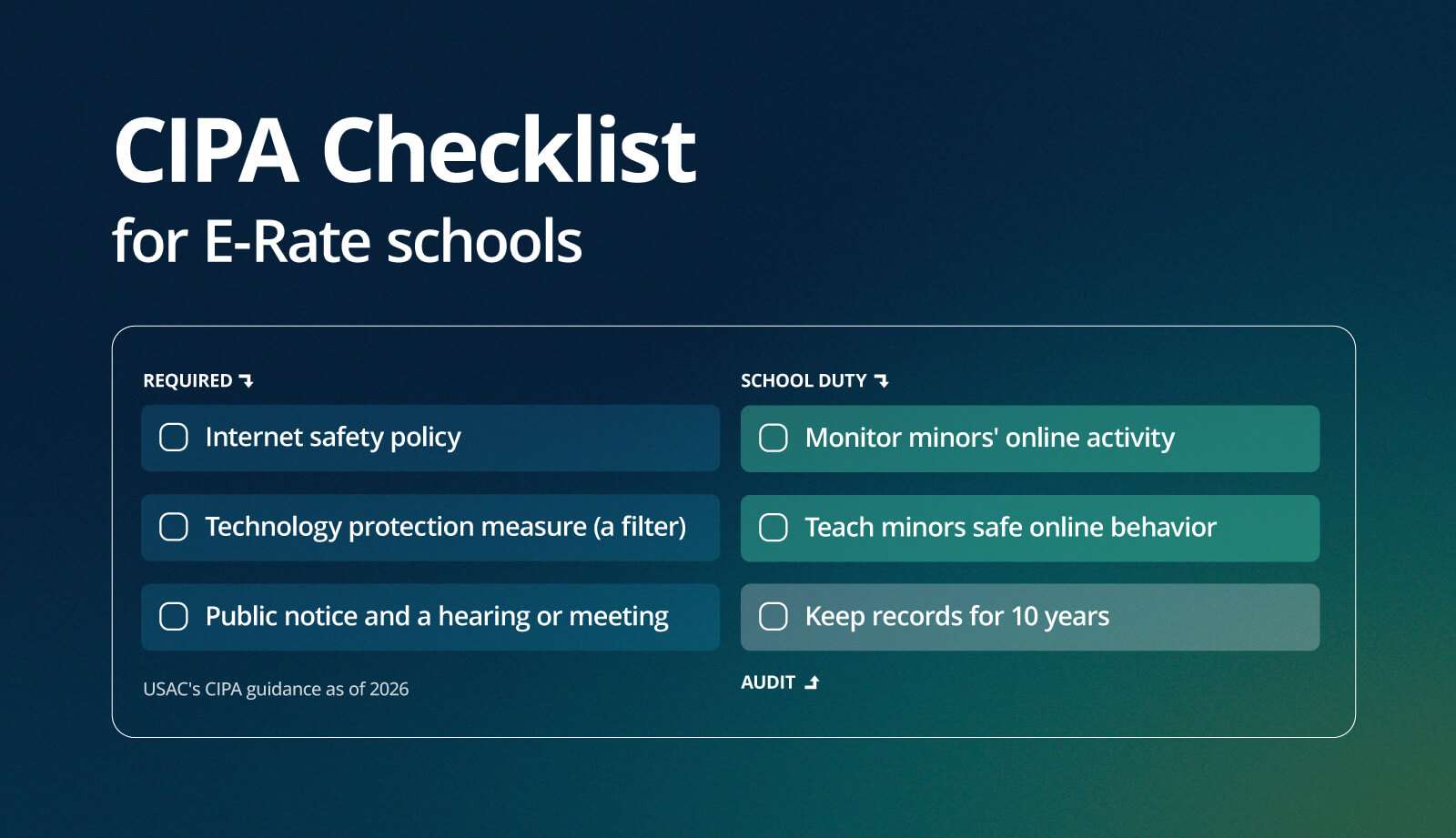
Schools must certify compliance with the Children’s Internet Protection Act (CIPA) to receive discounts on Category One internet access and all Category Two services.
USAC’s CIPA guidance lists three requirements:
- An internet safety policy. The policy must address minors’ access to inappropriate matter, safety in email and chat, unauthorized access, disclosure of personal information, and measures restricting harmful material.
- A technology protection measure. This is a specific technology that blocks or filters internet access to visual depictions that are obscene or harmful to minors.
- Public notice and a hearing or meeting. The school must give reasonable public notice and hold at least one public hearing or meeting on the policy.
Schools have two added duties. Their policies must include monitoring the online activities of minors and educating minors about appropriate online behavior. In an audit, USAC asks for the policy, proof of the public meeting, a description of the filter and reports showing the filter was working, and records must be kept for at least 10 years.How CIT helps schools stay CIPA compliant
CIPA applies to the school or library that receives E-Rate discounts, so your board remains the party that certifies compliance. CIT helps Minnesota schools and districts meet the technical side of CIPA with network content filtering and continuous monitoring from our
24/7 managed SOC. Our free
cybersecurity gap analysis is a great start to see where your district stands on risk and compliance.
One Minnesota budgeting note: state equity aid does not reimburse the purchase or installation of internet filtering, so budget for filtering separately.
How do you choose an IT provider that supports E-Rate in Minnesota?
Choose on evidence you can check against USAC rules. Applicants must select the most cost-effective offering, using the price of eligible equipment and services as the primary factor. Within that rule, these eight checks separate E-Rate-ready providers from general IT vendors.
| What to check | Why it matters |
|---|
| A Service Provider Identification Number (SPIN) | Providers need at least one SPIN to participate, and USAC cannot commit funds without the provider’s Form 498 |
| A current annual certification (Form 473) | Providers must file it each funding year before any invoice is paid |
| Hands off your Form 470 | A provider that helps prepare your Form 470 and then bids taints the process and can cause a funding denial |
| Quotes that separate eligible from ineligible items | Mixed products need a cost allocation |
| A clear invoicing method | You choose between discounted bills (SPI) and reimbursement (BEAR) |
| A realistic install schedule | Equipment must be delivered and installed by September 30 after the funding year |
| Ten-year record keeping | Bids, contracts and delivery records must be retained and produced for audits |
| Readiness for the FY2028 bidding portal | Providers will submit bids through a USAC-managed portal |
Two more questions are worth asking any Minnesota provider:
- Can you support what E-Rate does not fund? Help desk, endpoint security and advanced firewall features sit outside the Eligible Services List, so the same partner needs a plan for both sides of the budget.
- Do you know the gift rules? USAC enforces gift rules for applicants and service providers during competitive bidding.
How CIT supports Minnesota schools with E-Rate projects
CIT is a Woodbury-based IT provider that has been rooted in the Twin Cities since 1992 and provides
managed IT and cybersecurity for K-12 schools and districts in Minnesota and Wisconsin. CIT is a registered E-Rate service provider, and we work with schools across the full network project by responding to schools’ competitive bids, delivering installation, and providing ongoing management. Across 150+ funded E-Rate requests since 2017, USAC has committed more than $7.3 million in E-Rate funding to schools on projects CIT delivered.
Here is where CIT fits on both sides of the eligibility line.
CIT works with districts as large as South Washington County Schools, with 19,000 students, and with private and parochial schools such as St. John the Baptist Catholic School. For South Washington County Schools, CIT
deployed more than 1,800 cameras and 60 integrated intercoms on a single network, and investigation times fell by 50 percent.
Planning a Category Two project for funding year 2027? Talk with a CIT education expert or start with a
cybersecurity gap analysis to see what E-Rate can and cannot cover in your network. More school IT guidance is in our
education resources library, including
network modernization headaches for K-12 IT directors.
CIT is a Top 10 Minnesota E-Rate Provider
ranked by combined customers served and funding committed.
Source: USAC.Frequently asked questions about E-Rate in Minnesota
Does CIT provide IT services for Minnesota schools?
Yes. CIT provides
managed IT, security, and networking services for K-12 schools and districts in Minnesota and western Wisconsin, including public districts, charter schools and private and parochial schools.
Does CIT support E-Rate funded projects?
Yes. CIT supports Minnesota schools with E-Rate Category Two network projects, including switching, cabling and wireless, and helps schools plan which parts of a technology budget E-Rate can and cannot cover. In funding year 2026, USAC funded E-Rate requests naming CIT as the service provider for Minnesota schools, covering switches, cabling and managed internal broadband services.
Does CIT help Minnesota schools meet CIPA requirements?
Yes. CIT helps schools meet the technical side of CIPA with network content filtering, continuous monitoring from a
24/7 managed SOC and a compliance-focused gap analysis. CIPA applies to the school or library receiving E-Rate discounts, so the school’s board still adopts the policy and certifies compliance.
Does E-Rate pay for managed IT services or a help desk?
Not for general managed IT. E-Rate funds managed internal broadband services, meaning third-party operation, management and monitoring of eligible internal connections such as managed Wi-Fi. Support for laptops, tablets and other end-user equipment is the school’s responsibility.
Does E-Rate cover cybersecurity or firewalls?
Only basic firewalls. The 2026 list keeps basic firewall services and components eligible and excludes advanced or next-generation firewall features. The FCC is testing broader security funding in a separate Cybersecurity Pilot Program.
Can private, parochial and charter schools in Minnesota get E-Rate?
Yes, in most cases. Non-profit schools with endowments of $50 million or less qualify, and public charter schools are named in the federal definition. Minnesota districts must also provide telecommunications access services to nonpublic schools on request under the state aid program.
What is the E-Rate Category Two budget per student?
It is $201.57 per student for funding years 2026 through 2030, with a $30,175 floor. The amount is pre-discount and covers the full five years.
When is the next E-Rate application deadline?
The funding year 2027 Form 471 window opens in early 2027, and USAC has not posted exact dates. Form 470 must be certified at least 28 days before you file Form 471, so bidding needs to start well before the window closes.
Do Minnesota schools have to apply for E-Rate?
Only if they want state equity aid. Minnesota law makes an E-Rate application a condition of Telecommunications/Internet Access Equity Aid, and that statute is repealed for revenue in fiscal year 2028 and later.
Is E-Rate funding at risk?
Funding year 2026 is fully funded. The FCC is also reviewing the program’s scope in an open rulemaking, so rules for later years could change.
Can an IT provider fill out our E-Rate forms?
Not the bidding form. A provider that will bid cannot complete your FCC Form 470, and the applicant is responsible for a fair and open process. Providers file their own forms, including the Form 474 service provider invoice.
Does CIT have experience with E-Rate funded projects?
Yes. CIT is an E-Rate service provider and supports schools through the E-Rate process, from the competitive bidding stage through installation and invoicing. USAC’s public data shows 180+ funded E-Rate requests naming CIT as the service provider from funding years 2017 to 2026. Those requests total more than $7 million in E-Rate funding committed to schools, covering work such as switches, cabling and managed internal broadband services. To talk through a project,
contact CIT.
Sources and further reading
This guide is general information, not legal or procurement advice. E-Rate rules, deadlines, funding levels and state programs can change, and this information may have changed since it was posted. Confirm current rules with USAC, the FCC, and the Minnesota Department of Education before you plan, bid, or file.