Future-Proofing Your Wireless Network for Emerging K-12 Learning Applications
The Growing Bandwidth Needs of Digital Learning: A Modern Challenge for Schools
Remember when a computer lab was the height of technology in schools? Those days are long gone. Today’s classrooms are digital powerhouses, and they’re hungry for bandwidth. Let’s dive into the world of K-12 wireless networks and explore the challenges schools face in keeping up with the digital revolution.
A Bandwidth Explosion
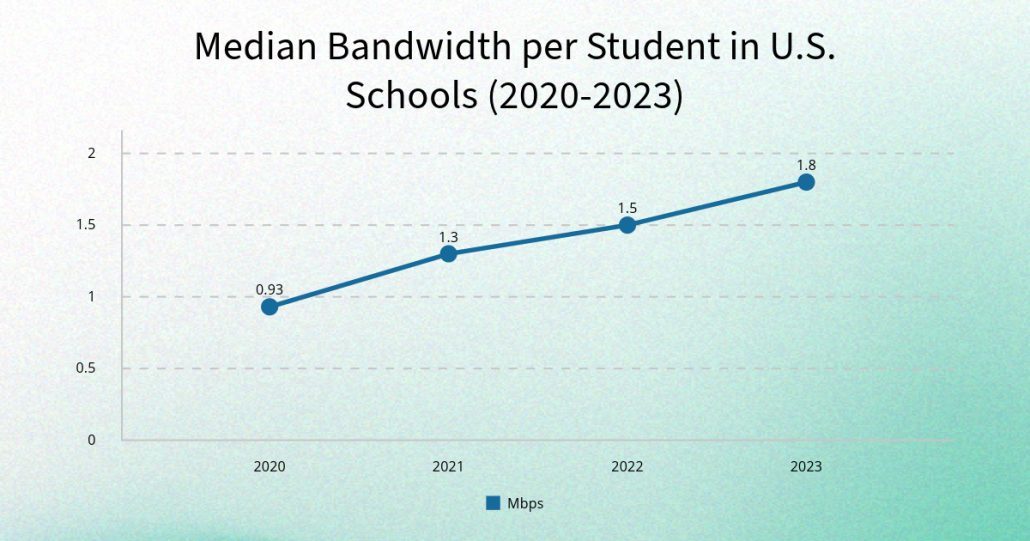
Imagine this: In 2020, the median bandwidth per student in U.S. schools was 0.93 Mbps. Fast forward to 2023, and that number has skyrocketed to 1.80 Mbps. That’s not just growth; it’s a significant bandwidth increase of nearly 94% in just three years!
The report highlights this remarkable progress:
- As of 2023, 74% of all school districts are now meeting or exceeding the FCC’s recommended bandwidth goal of 1 Mbps per student — an increase of 57.4% since 2020.
- This progress means that 27.1 million students now have the access necessary to participate in immersive digital learning opportunities in their classrooms every day.
- The median cost per megabit has steadily decreased from $1.85 in 2020 to $1.01 in 2023, making bandwidth upgrades more affordable for schools.
This dramatic increase in bandwidth availability reflects the growing importance of digital learning technologies and applications in classroom pedagogy, as well as the prioritization of connectivity by state and school district leaders. [1]
What’s driving this insatiable appetite for data? It’s a perfect storm of:
- 1:1 device programs putting a tablet or laptop in every student’s hands
- Video streaming becoming as common as textbooks
- Cutting-edge educational apps that would make sci-fi writers jealous
And this trend isn’t slowing down. A whopping 95% of school districts are bracing for even more significant bandwidth increases in the next three years [2]. It’s like trying to fill a leaky bucket – the demand keeps growing faster than schools can keep up!
When Good Lessons Go Bad
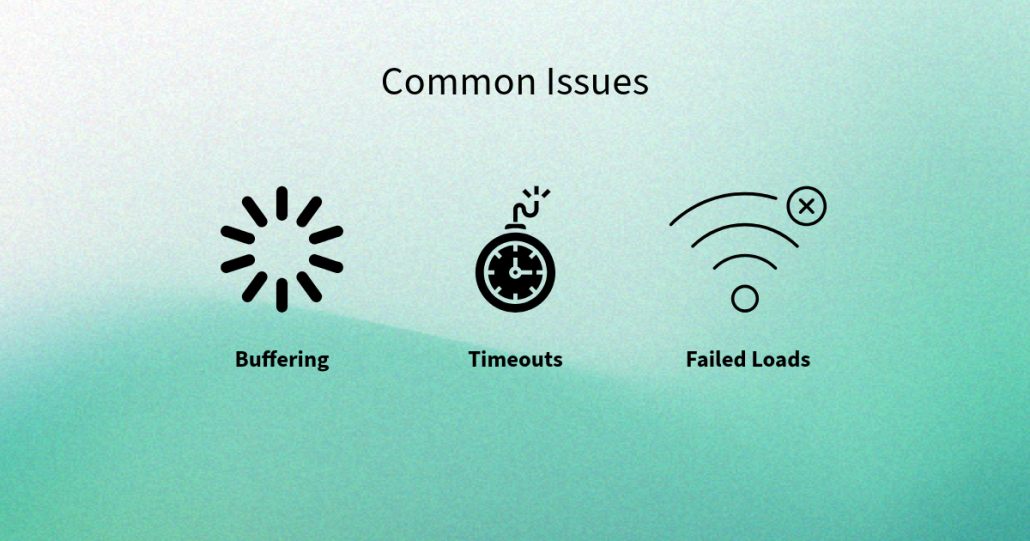
Picture this: A science teacher, excited to show her students a virtual dissection, clicks play on the video. But instead of amazed gasps, she’s met with groans as the loading icon spins… and spins… and spins.
This isn’t just a hypothetical. From videos stuck buffering to websites timing out, teachers across the country are facing digital frustrations daily.
Take the case of a high school science teacher who planned an interactive lab in the school cafeteria. It should have been a recipe for engagement. Instead, it became a lesson in disappointment as the school’s WiFi couldn’t handle the load, leaving students staring at blank screens instead of molecules.
Out With the Old, In With the New
The culprit behind many of these digital dilemmas? Outdated infrastructure. Many schools are still relying on legacy 802.11n networks, which offer speeds up to 600 Mbps. While that might sound fast, it’s like trying to fit a modern highway’s worth of traffic down a country lane [3].
Enter Wi-Fi 6 (802.11ax), the superhero of wireless networks. With theoretical speeds up to 9.6 Gbps and the ability to handle more users simultaneously, it’s tailor-made for the demands of modern classrooms [4].
The Road Ahead
But upgrading isn’t as simple as flipping a switch. Schools face a gauntlet of challenges:
- Finding room in tight budgets for new equipment
- Training staff on new systems
- Ensuring older devices don’t get left in the digital dust
Despite these hurdles, the future of education is undeniably digital. As we continue to push the boundaries of what’s possible in the classroom, our networks will need to keep pace. It’s a challenging journey, but one that promises to unlock incredible opportunities for the next generation of learners.
Supporting High-Density Environments: When Classrooms Go Beyond Four Walls
Picture this: A bustling school cafeteria transformed into a hive of digital activity. Students huddled around tables, tablets in hand, collaborating on a virtual science fair project. In the corner, a group livestreams their debate practice to peers across the country. This isn’t a scene from a futuristic edu-topia – it’s the reality of modern K-12 education.
The New Frontier of Digital Learning
Gone are the days when learning was confined to classrooms. Today’s instructional approaches are breaking down walls – literally. Cafeterias, gymnasiums, and libraries have become hotspots for collaborative digital learning experiences. It’s a pedagogical revolution that’s pushing the boundaries of traditional education… and pushing school networks to their limits [5].
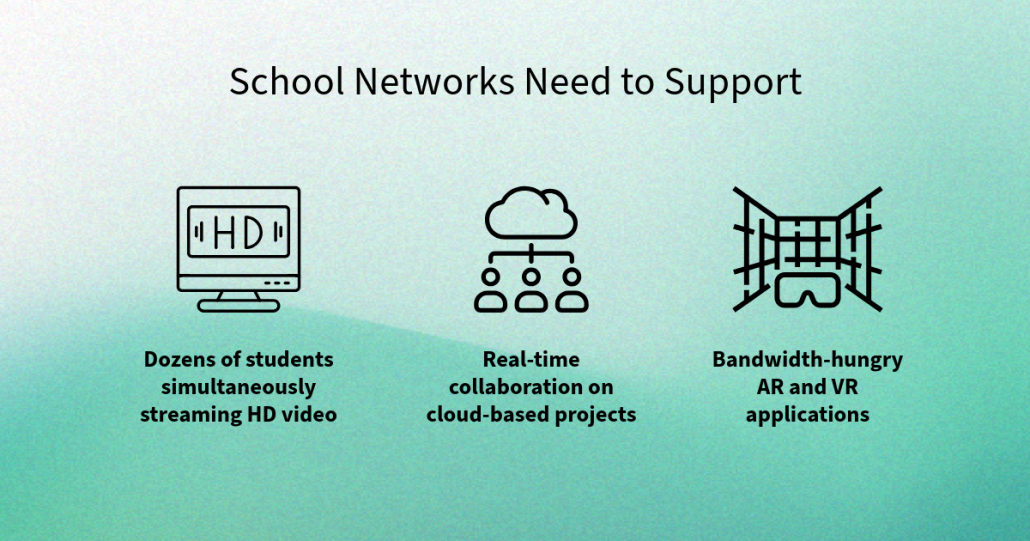
In these high-density environments, a robust and high-capacity wireless network isn’t just nice to have – it’s essential. We’re talking about supporting:
- Dozens of students simultaneously streaming HD video
- Real-time collaboration on cloud-based projects
- Bandwidth-hungry AR and VR applications
It’s like trying to direct rush hour traffic through a small town’s main street. Without the right infrastructure, digital gridlock is inevitable.
When Good Intentions Meet Bad Connections
The vision of seamless digital collaboration often crashes into the harsh reality of WiFi woes. Common areas frequently become digital dead zones, plagued by:
- Weak signal strength that drops faster than a student’s motivation on a Friday afternoon
- Coverage gaps that turn “bring your own device” into “bring your own frustration”
- Network congestion that makes molasses look speedy
A 2021 survey by the Consortium for School Networking found that 90% of IT leaders identified “addressing network capacity for growing number of devices” as a major challenge [6]. It’s a digital tug-of-war, with teachers and students on one side and an overloaded network on the other.
Building a Network That Makes the Grade
So, how do we turn these digital dreams into reality? It starts with a wireless network architecture that’s as forward-thinking as the learning it supports. Here’s what it takes:
- High-Density Heroes: Access points designed to handle crowds. The Cisco Meraki MR46, for instance, can support up to 1,024 client associations per radio [7]. That’s enough for even the most device-happy student body!
- Intelligent Design: RF management that adapts faster than a teenager’s social media habits. Solutions like Aruba’s AirMatch use machine learning to optimi7 e channel selection, transmit power, and client connections in real-time [8].
- Roaming Without Roaming Charges: Seamless roaming capabilities ensure students stay connected as they move from classroom to cafeteria without missing a digital beat.
- Future-Proofing: With WiFi 6E on the horizon, planning for multi-gigabit speeds and ultra-low latency is crucial. The additional 6 GHz spectrum could be a game-changer for high-density environments [9].
The Payoff: Digital Learning Unleashed
When connectivity issues become a thing of the past, the possibilities are endless. Imagine:
- A school-wide virtual science fair where students showcase AR models of their experiments
- Real-time collaborative coding sessions in the library
- Global language exchanges happening seamlessly in the courtyard
By eliminating the technical hurdles, we allow educators to focus on what they do best: inspiring and guiding the next generation of learners.
As we continue to push the boundaries of what’s possible in education, our networks need to keep pace. It’s not just about faster speeds or more coverage – it’s about creating an environment where technology enhances learning rather than hindering it. In the digital age, a robust wireless network isn’t just part of a school’s infrastructure – it’s the foundation upon which the future of education is built.
The Importance of a Flexible, Scalable Architecture
In today’s rapidly evolving educational landscape, K-12 organizations require a wireless network architecture that can easily scale and adapt to meet the growing connectivity demands of digital learning initiatives. A distributed access point model with centralized management offers the flexibility and scalability needed to cost-effectively accommodate increasing numbers of devices and bandwidth-intensive applications [10].
A distributed access point architecture allows for seamless addition of APs to increase capacity and coverage as needed, without necessitating a complete overhaul of the existing network infrastructure. Centralized management, whether through a cloud-based or on-premises controller, simplifies provisioning, configuration, and monitoring of the wireless environment from a single, unified interface [11].
This centralized visibility empowers IT staff to swiftly identify issues such as RF interference and troubleshoot problems across multiple sites. Education-specific solutions often include robust features like:
- Location services
- Application visibility and control
- Self-healing mechanisms
- IoT integration capabilities
These features support advanced teaching and learning applications, enhancing the overall educational experience [12].
As learning models continue to evolve, this flexible, scalable architecture ensures that schools can readily adapt their wireless infrastructure to embrace new educational technology innovations without incurring significant rip-and-replace costs. The ability to manage and scale the wireless network incrementally provides a future-proof foundation for digital transformation in education [13].
Building a Future-Ready Wireless Foundation
To effectively future-proof wireless networks for emerging digital learning innovations, K-12 institutions should consider deploying high-performance access points (APs) with advanced capabilities. These modern APs offer the processing power, resilience, and software-defined architectures necessary to adapt seamlessly to the evolving connectivity demands of education [14].
State-of-the-art AP hardware features:
- Multi-gigabit throughput
- High user density support
- Robust security capabilities
These features enable the latest APs to efficiently handle bandwidth-intensive applications such as 4K video streaming, virtual/augmented reality experiences, and large-scale online testing scenarios. Additionally, their programmable chipsets allow for new services to be enabled through software updates, protecting infrastructure investments [15].
Industry-leading solutions, such as Wi-Fi 6 (802.11ax) APs, have been recognized by analysts as setting new standards for wireless networking performance and flexibility. These advanced APs often include features like:
- AI-powered RF optimization
- Self-healing mesh recovery
- IoT integration capabilities
These features collectively deliver an enhanced connectivity experience that positions schools for the future of digital learning transformation [16].
By implementing a software-defined wireless foundation, schools can cost-effectively scale and evolve their networks over time through cloud-managed firmware updates and service additions. This approach future-proofs their infrastructure for immersive education innovations on the horizon, such as:
- Holographic lectures
- Real-time AR-guided lessons
- Globally-connected remote classrooms4
This revised version maintains a professional tone while avoiding specific brand endorsements. It also includes reputable sources to support the claims made about wireless networking technology and its potential impact on education.
Partnering for Success
Keeping pace with the rapidly evolving digital education landscape requires more than just implementing the latest wireless technology. It demands a strategic partnership with a solutions provider that truly understands the unique needs and challenges of the K-12 environment.
By collaborating with an experienced education technology partner like CIT, school districts can design and deploy wireless networks tailored to their specific requirements – from supporting robust 1:1 device programs to enabling innovative AR/VR learning applications. Our team brings expertise in architecting high-density, high-performance wireless solutions optimized for the modern classroom.
Moreover, CIT serves as more than just a vendor – we become an invested partner in your district’s long-term success. We proactively monitor technology roadmaps and provide guidance to future-proof investments. Our education focus enables us to anticipate emerging needs and recommend solutions that will seamlessly scale.
For example, our education team may recommend a cloud-managed wireless architecture that simplifies network operations through a single pane of glass. This allows small IT teams to efficiently monitor performance across all schools and easily troubleshoot from anywhere. As new demands arise, access points can be seamlessly added without overhauling infrastructure.
Ultimately, partnering with CIT ensures your wireless network investment provides a secure, reliable foundation to unleash the full potential of digital learning – both now and in the future. Contact us today to learn how we can support your school district’s wireless networking needs and help you navigate the evolving landscape of educational technology.
References:
- Connect K-12 2023 Report
- Education SuperHighway. (2022). State of the States Report 2022.
- Consortium for School Networking. (2021). CoSN’s 2021 K-12 Leadership Survey Report.
- Aruba Networks. (2021). 802.11ax (Wi-Fi 6) and Education.
- Wi-Fi Alliance. (2023). “Wi-Fi 6E: The Next Evolution of Wi-Fi.”
- EdTech Magazine. (2022). “K–12 Schools Reimagine Learning Spaces to Support Ed Tech.”
- Cisco Meraki. (2023). “MR46 Datasheet.”
- Aruba Networks. (2022). “AI-Powered Optimization for Aruba Wireless Networks.”
- Gartner. (2020). “Top 10 Strategic Technologies Impacting Education in 2020.”
- Cisco. (2021). “Cisco DNA for Education: The Future of Learning.”
- Aruba Networks. (2022). “K-12 Education Solutions.”
- Extreme Networks. (2021). “K-12 Education Solutions.”
- UNESCO. (2020). “Education in a post-COVID world: Nine ideas for public action.”
- Gartner. (2021). “Market Guide for Wireless LAN Infrastructure and Services.”
- IEEE. (2021). “IEEE 802.11ax-2021: Wi-Fi 6 Release 1.”
- IDC. (2020). “IDC MarketScape: Worldwide Enterprise WLAN 2020 Vendor Assessment.”