Every Security Exception is a Decision. Are Yours Documented?
Summary
- A recent Barracuda study shows that 100% of organizations granted at least one security exception last year, proving that exceptions are an unavoidable operational reality.
- Undocumented exceptions lead to "exception creep," creating severe visibility gaps that compromise endpoint detection and compliance frameworks.
- Lean IT teams can manage risk by implementing a four-step framework: standardized requests, compensating controls, automated expiration, and a centralized ledger.
- Formalizing security exceptions transforms them into strategic risk decisions that help justify future security budget and tooling investments.
A recent industry study by Barracuda found every surveyed organization granted at least one security exception last year. For lean IT teams, these exceptions are more than temporary workarounds. They are high-stakes risk decisions. They must be documented to maintain compliance and protect the organization’s attack surface.
The Reality of the 100% Exception Rate
Modern organizations cannot operate under absolute, unyielding restrictions, making security exceptions an operational necessity for business enablement. According to Barracuda, every single surveyed organization approved at least one security policy bypass last year, highlighting the urgent need to transition from ad-hoc, informal approvals to structured, documented risk management.
In lean IT environments, pressure to maintain operational velocity often leads to rapid workarounds. A developer may need temporary local administrative rights. An executive may request an exemption from multi-factor authentication while traveling. A legacy application may not support modern security protocols. Security exceptions are inevitable.
However, when these exceptions are granted without a formal review process, they bypass the very protections established by platforms like Microsoft Entra ID or Okta. To balance security with productivity, organizations must recognize that an exception is not a failure of policy—it is a conscious business decision to accept a specific level of residual risk.
Why Undocumented Exceptions Create Invisible Vulnerabilities
Undocumented security exceptions create critical visibility gaps that threat actors actively exploit to compromise corporate networks. Without a centralized ledger, temporary bypasses frequently become permanent vulnerabilities, rendering advanced detection tools from CrowdStrike or SentinelOne less effective because security teams lose the context needed to distinguish authorized anomalies from active attacks.
When an exception is granted informally—such as through a quick Slack message or an undocumented helpdesk ticket—it lacks an expiration date. Over time, these undocumented exemptions accumulate, a phenomenon known as “exception creep.”
This accumulation severely compromises your defensive posture in several ways:
- Impaired Incident Response: If SentinelOne flags an unusual administrative action, incident responders cannot quickly verify if the behavior is an approved developer exception or an active intrusion.
- Compliance Failures: During audits for frameworks such as SOC 2, HIPAA, or PCI-DSS, undocumented policy deviations can result in immediate non-compliance findings.
- Policy Erosion: When employees observe that security policies can be bypassed informally, the overall security culture of the organization weakens.
A 4-Step Framework for Managing Security Exceptions
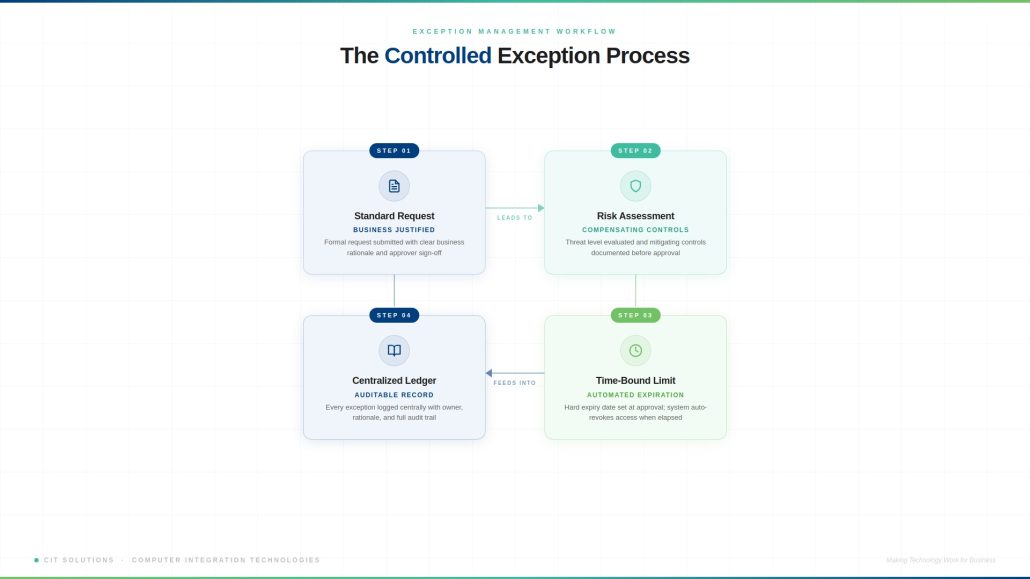
Lean IT teams can regain control of their risk posture by implementing a lightweight, structured exception lifecycle. This framework ensures every policy bypass is formally requested, risk-assessed, bounded by time, and continuously monitored using automated platforms like Threatlocker or Fortinet.
1. Standardize the Request and Justification Process
Every security exception must begin with a formal request that details the business necessity. The requester must explain why the security policy prevents them from performing their job. They must also describe the specific activities they need to conduct. This shifts responsibility for risk acceptance to the business unit leader. It ensures IT is not solely responsible for operational risk.
2. Quantify the Risk and Identify Compensating Controls
Before approving an exception, IT leaders must evaluate the potential impact. If a legacy system requires an exception to bypass network segmentation on your Fortinet firewalls, you must implement compensating controls. For example, you might deploy Threatlocker to ringfence the application, strictly limiting what resources it can access on the network despite the broader firewall exemption.
3. Implement Strict Time Limits and Automated Expirations
No security exception should be permanent. Every approved request must have a defined expiration date, typically spanning from a few hours to a maximum of 90 days. For identity-based exceptions, leverage features like Microsoft Entra Privileged Identity Management (PIM) or Okta Access Requests to automatically revoke elevated permissions once the approved timeframe expires.
4. Maintain a Centralized, Auditable Exception Ledger
All exceptions must be recorded in a single, secure repository. This ledger should capture the date of approval, the business justification, the compensating controls implemented, the approving authority, and the scheduled review or expiration date. This centralized record serves as your single source of truth during internal security reviews and external compliance audits.
Transforming Exceptions into Strategic Risk Decisions
Documenting security exceptions shifts the IT department from a perceived operational bottleneck to a strategic partner in business enablement. By formalizing this process, lean IT leaders can clearly communicate residual risks to executive leadership, justifying future security investments with partners like Barracuda and Kaseya.
When IT leaders present a clear, quantified list of active security exceptions to the board, the cybersecurity conversation changes. Instead of discussing abstract threats, they can point to concrete operational dependencies. These include legacy software requiring policy exemptions. They can also show exactly where additional security investments are needed. Those investments help permanently close security gaps.
At CIT Solutions, we help lean IT teams design, implement, and manage robust security governance frameworks that balance operational agility with rigorous risk management. By partnering with industry leaders like Barracuda, Threatlocker, and Microsoft, we ensure your organization remains resilient, compliant, and fully in control of its digital footprint.
Learn More about CIT Solutions Security Governance Services
Barracuda Blog | https://blog.barracuda.com/2026/05/20/security-exceptions-cybersecurity-risk