Meeting AI Where It Happens: Why Every Industry Now Needs High-Powered Workstations
AI is pushing the limits of what’s possible in every industry—from predictive maintenance in manufacturing to real-time fraud detection in finance to generative design in architecture. But as AI grows more capable, it also grows more demanding.
Enterprise leaders are now facing a fundamental shift: to fully leverage AI, computing power needs to move closer to where data is created, and decisions are made – and that means rethinking infrastructure. High-performance NVIDIA RTX™-powered HP AI workstations enable this new reality.
Let’s break down why.
AI’s Expanding Footprint
Generative AI is no longer a trend—it’s becoming embedded in how businesses operate. According to research from HP and NVIDIA, 95% of executives believe AI will force their organizations to modernize their tech stacks. That’s not surprising, considering the scale of the workloads involved.
Training a single large language model (LLM) can take thousands of GPUs running for weeks. But that’s just part of the story. Day-to-day AI tasks—like fine-tuning smaller models, running inference, or processing unstructured data—are increasingly happening outside of data centers. On factory floors, in hospitals, at construction sites, and inside creative studios, AI is becoming decentralized.
As Gartner predicts, by 2025, 75% of enterprise data will be created and processed outside traditional data centers and cloud environments. That’s where workstations come in.
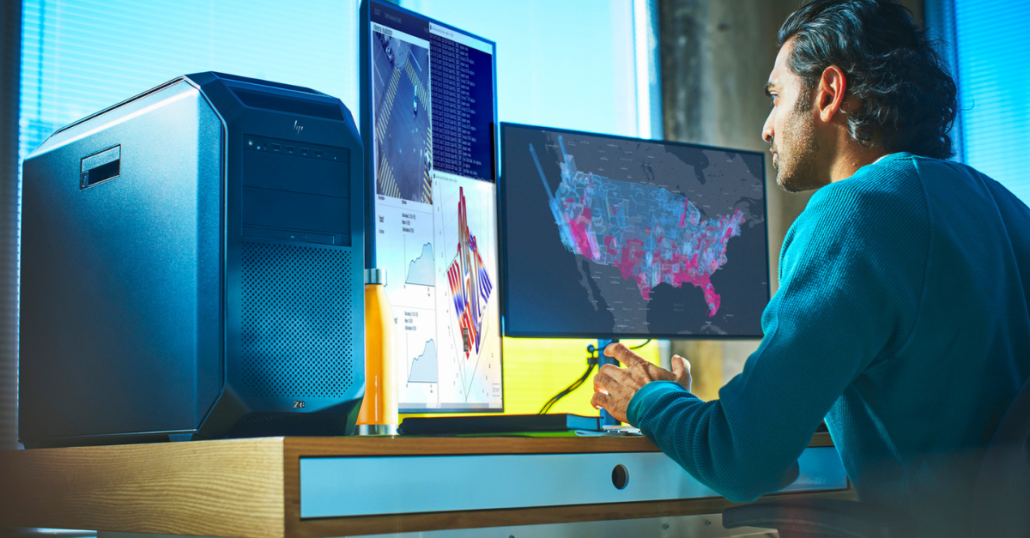
From Bottleneck to Breakthrough: The Role of AI Workstations
Workstations offer a powerful, practical way to bring AI to the edge—where real work is happening. They provide the GPU muscle and memory needed to run advanced models locally, without depending entirely on overburdened cloud resources.
Enter the Z by HP Workstation, Powered by NVIDIA RTX
HP’s Z8 Fury and Z8 G5 are designed with AI in mind. These systems support up to four NVIDIA RTX 6000 Ada Generation GPUs, with 192GB of combined GPU memory, and deliver up to 5.8 petaflops of AI compute performance. That’s not just impressive—it’s transformational.
Whether you’re experimenting with generative AI models, accelerating simulation workflows, or doing real-time inferencing, these machines make it possible to:
- Train models locally to reduce cloud costs and latency
- Run high-resolution, GPU-intensive applications simultaneously
- Perform real-time analytics directly at the data source
Industry at the Edge: Use Cases in Action
Architecture, Engineering, and Construction (AECO)
Generative AI is already improving how architects and engineers approach design. With workstations, they can simulate structural integrity, test energy efficiency, and even predict maintenance needs—all without waiting on remote resources.
Manufacturing
In product development, AI workstations speed up simulation cycles and enable generative design based on historical product data. In smart factories, they run video and 3D simulations to optimize layout and predict inefficiencies before they occur.
Data Science
Data scientists need low-latency, high-performance environments to iterate quickly. Local workstations give them that—along with tools like the Z by HP Data Science Stack Manager and preloaded open-source frameworks such as RAPIDS, PyTorch, and TensorFlow.
Creative Workflows
From real-time rendering in Unreal Engine to simulation-heavy VFX workflows, artists and animators need systems that can handle multiple GPU-intensive apps at once. The Z8 Fury brings together processing power and flexibility so creatives can work without compromise.
A Smarter Way to Scale AI
One of the biggest advantages of using high-performance AI workstations is flexibility. They don’t replace the cloud—but they do reduce your dependency on it. HP’s Z workstations are designed to integrate easily with data centers and cloud services when needed, while keeping workloads local when that makes more sense for security, cost, or speed.
And with tools like HP Anyware, IT teams can manage and support remote users securely, enabling hybrid and distributed teams to tap into workstation power from anywhere.
Making the Case to IT Leaders
Here’s the bottom line: if your teams are working with AI, the old approach to computing isn’t enough. You need systems that are purpose-built for demanding, data-intensive tasks.
HP and NVIDIA have created workstations that are enterprise-grade, scalable, and ready for AI from day one. Whether you’re building models, analyzing massive datasets, or bringing AI to the edge, this is the infrastructure that makes it possible.
Ready to explore what AI workstations could do for your business?
Contact us to see how Z by HP can help your teams move faster, work smarter, and stay in control—wherever AI takes them.