The ROI of Resilience: Why NIST CSF 2.0 Is a Non-Negotiable Framework for Businesses
Summary
- NIST CSF 2.0 is a strategic business framework, not just a technical checklist. Its new "Govern" function elevates cybersecurity to a board-level responsibility, focusing on risk tolerance and accountability.
- The financial stakes are higher than ever for Midwest businesses, with downtime costs reaching up to $100,000 per hour. Inaction is no longer a viable option.
- Adopting the framework delivers a tangible ROI through breach prevention (11x return), significantly lower cyber insurance premium growth, and a strong competitive advantage in the supply chain.
- For mid-market businesses facing talent and budget shortages, partnering with a Managed Security Service Provider (MSSP) is the most effective way to implement CSF 2.0 and achieve 24/7 threat detection and response.
For business leaders, the cost of a single hour of operational downtime can reach an astonishing $100,000. This isn’t a scare tactic; it’s the new financial reality in an era of automated, sophisticated cyberattacks. The NIST Cybersecurity Framework (CSF) 2.0 is the first major update in a decade, providing a strategic blueprint that transforms cybersecurity from a technical IT problem into a core business function focused on resilience and profitability.
This guide breaks down why NIST CSF 2.0 is essential for your organization, translating its core principles into the language of business risk, ROI, and competitive advantage.
Key Takeaways:
- Governance is the Game-Changer: The new “Govern” function elevates cybersecurity to the executive level, forcing strategic conversations about risk tolerance and resource allocation before a single technical control is chosen.
- It’s Designed for You: CSF 2.0 has expanded its scope beyond critical infrastructure to be accessible and applicable for organizations of all sizes, including mid-market businesses in sectors like manufacturing, healthcare, and finance.
- Resilience Has a Measurable ROI: Adopting the framework can deliver an 11x return on investment by preventing costly breaches, lower cyber insurance premiums by a third, and give you a significant competitive advantage in the supply chain.
- It Addresses Your Biggest Threats: The framework provides a clear structure for managing the two most significant modern risks: sophisticated supply chain attacks and the internal threat of unmanaged “Shadow AI.”
The Unacceptable Cost of Inaction: The 2025 Tipping Point
For mid-market businesses, the threat is no longer abstract. Attackers are using automated tools to target industries with “operational urgency”, like manufacturing and healthcare, where any downtime guarantees immediate financial pain. With reported incidents against SMBs jumping 16% recently, the risk is escalating rapidly.
The disconnect is dangerous: while up to 72% of SMBs reported a breach in the last year, 57% of owners still believe they won’t be a target. This perception gap leads to underfunding and unpreparedness, creating the perfect storm for a catastrophic event.
Quantifying the Financial Damage
The average cost of a breach for an SMB now sits between $140,000 and $164,000, but the real business impact is operational downtime.
Consider these figures:
- Cost of Downtime: Up to $100,000 per hour for service or e-commerce firms.
- Average Disruption: 22 hours of disruption per incident.
- Recovery Lag: 50% of businesses take more than 24 hours to become operational again.
When a 22-hour outage can cost over $2 million, it becomes clear that business resilience isn’t an IT issue.
| Metric Category | 2025 Quantification (SMB 50-500 Employees) | Source Context |
|---|---|---|
| Average Breach Cost | $140,000 to $164,000 per incident | Up 13% from the previous year. |
| Downtime Cost (Per Hour) | Up to $100,000 per hour | A conservative estimate for service-based businesses. |
| Median Downtime Duration | 22 hours of disruption | Time required to become operational again after an attack. |
| Ransomware Incidence | Tied to 75% of system intrusion breaches | Ransomware remains a dominant and crippling threat. |
NIST CSF 2.0: Shifting Cybersecurity to a Board-Level Mandate
The NIST CSF 2.0 is a voluntary, flexible framework that provides a shared language for managing cybersecurity risk. Its most transformative update is the introduction of a sixth core function: Govern (GV).
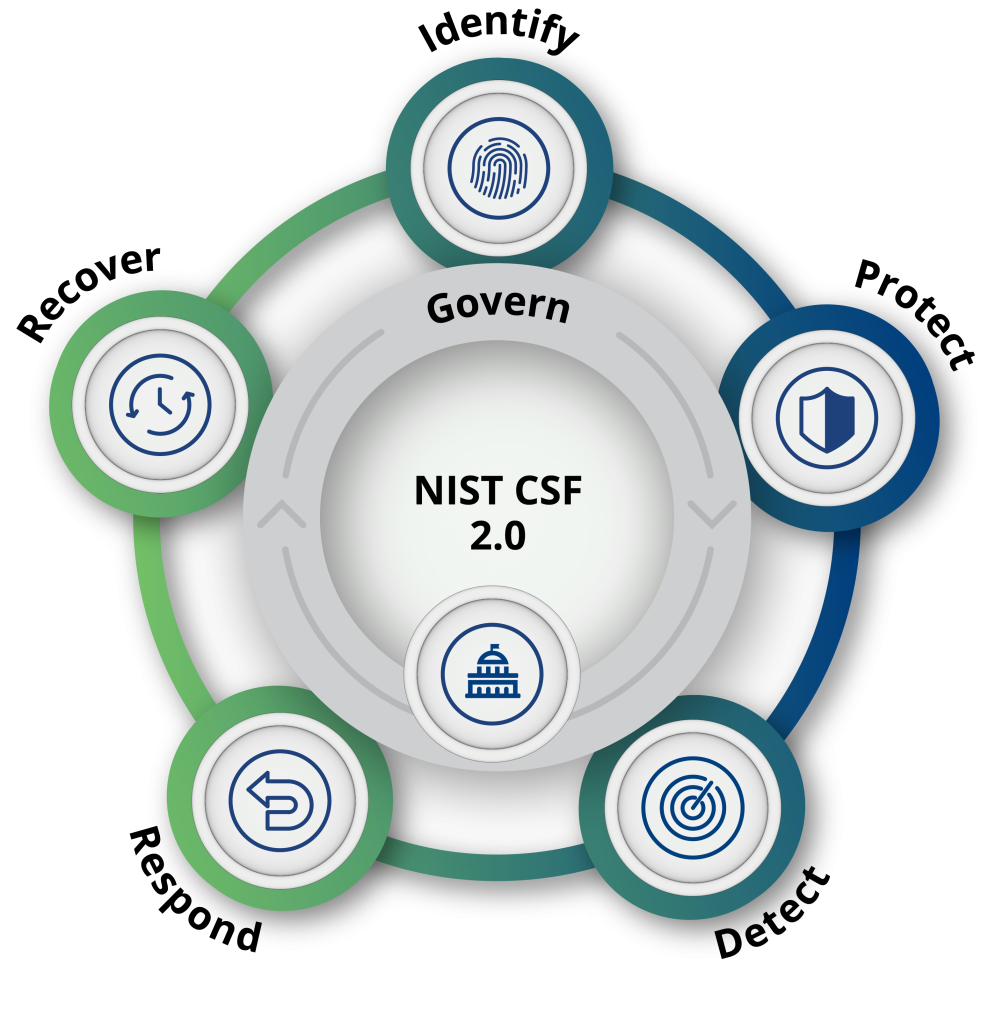
This function fundamentally changes the conversation. It moves cybersecurity from the server room to the boardroom, ensuring it is managed with the same strategic rigor as financial and operational risk. For businesses without a dedicated Chief Information Security Officer (CISO), the Govern function provides a clear roadmap for leadership accountability.
The Govern function forces leaders to answer critical business questions before discussing technology:
- Organizational Context (GV.OC): How does our security strategy support our primary business mission and revenue goals?
- Risk Management Strategy (GV.RM): What is our official tolerance for cyber risk, and how does it align with our overall enterprise risk management?
- Roles & Responsibilities (GV.RR): Who on the leadership team is ultimately accountable for cybersecurity risk and for allocating the necessary resources?
- Cybersecurity Supply Chain Risk Management (GV.SC): How are we vetting our vendors and managing the immense risk posed by third-party dependencies?
The 6 Functions of Resilience: A Deep Dive for Leaders
While Govern sets the strategy, resilience is built by executing the other five functions. Here’s what they mean for your business.
- Identify (ID): You can’t protect what you don’t know you have. This is about understanding your most critical assets, data, and systems; the things that, if disrupted, would halt your business.
- Protect (PR): This involves implementing safeguards. Crucially, this function highlights the human element. With 75% of ransomware attacks involving a human factor, but only 42% of SMBs providing regular security training, there’s a massive gap. Protection means investing in your people with training and implementing foundational controls like Multi-Factor Authentication (MFA).
- Detect (DE): This is about discovering threats in real time. In 2025, with AI-powered attacks on the rise, passive monitoring is no longer enough. For most SMBs, achieving the required 24/7 monitoring is impossible without partnering with a Managed Detection and Response (MDR) provider.
- Respond (RS): When an incident occurs, what’s the plan? A slow or disorganized response multiplies the damage. The Govern function ensures a formal incident response plan is in place, with clear roles and communication protocols.
- Recover (RC): This is your key to surviving an attack. A robust recovery plan directly mitigates the crippling cost of a 22-hour outage. Yet, an alarming 19% of small businesses have no backup or recovery plan. This function mandates tested, offsite, and immutable backups to ensure you can get back to business quickly.
Critical Focus: Managing Your Greatest External Threat
NIST CSF 2.0 places a heavy emphasis on Cybersecurity Supply Chain Risk Management (GV.SC) for a reason: it’s one of the biggest threats facing businesses today. With over 60% of workloads now sitting in cloud and SaaS environments, your risk extends far beyond your four walls.
The framework provides a structure to move beyond simple vendor questionnaires to a formal accountability model. It mandates that you:
- Establish clear security requirements for all suppliers and partners.
- Define roles and responsibilities in third-party agreements.
- Include critical suppliers in your incident response planning and testing.
This governance is also your best defense against “Shadow AI,” where employees use unvetted AI tools and paste sensitive company data into unprotected third-party systems. A formal policy (GV.PO) is the only way to manage this emerging data leakage threat.
The ROI of Resilience: A Clear Financial Advantage
Adopting NIST CSF 2.0 isn’t an expense; it’s one of the highest-return investments you can make. The data proves the financial logic of proactive security.
| Investment Outcome | Quantified Value or Statistic (2025) | NIST CSF 2.0 Mechanism |
|---|---|---|
| Return on Prevention | 11x ROI compared to the average cost of a single breach. | Guided resource allocation (GV.RR) to prevent incidents. |
| Cyber Insurance Savings | Organizations using CSF report one-third lower premium growth. | Demonstrates mature risk management (GV.RM) to underwriters. |
| Mitigating Downtime Loss | Prevents catastrophic $100,000/hour incidents and minimizes lost revenue. | Strong Respond (RS) and Recover (RC) functions ensure continuity. |
| Competitive Advantage | Positions your business to win contracts with larger enterprises that require documented security maturity. | The framework acts as a trusted, standardized benchmark. |
Overcoming the Implementation Hurdle
For many mid-market businesses, barriers like talent shortages (40% of SMBs) and budget constraints (40% of SMBs) can make adopting a framework like CSF 2.0 seem daunting. Building an in-house 24/7 Security Operations Center (SOC) is often prohibitively expensive.
This is where strategic outsourcing becomes the most pragmatic solution. A Managed Security Service Provider (MSSP) can bridge the talent and technology gap, providing the expertise and integrated architecture to implement the framework effectively. By leveraging services like AI-assisted MDR and SOC-as-a-Service, you can cost-effectively achieve the 24/7 detection and response capabilities required by CSF 2.0, turning the framework from an overwhelming document into an achievable operational mandate.
Listen to the Full Episode
Hear our cybersecurity experts break down NIST CSF 2.0 in plain English.
In this episode of Tech for Business, our CISO, vCISO, and Director of Cybersecurity go beyond the theory to discuss practical implementation steps, common pitfalls for SMBs, and how to use the “Govern” function to build a powerful business case for security investment.