From IT Bottleneck to Solution Builder: Your Guide to the Agentic SME with Microsoft Power Platform
Summary
- The "Agentic Stack"—Microsoft's Power Platform—allows non-technical employees to become "Citizen Developers," building custom apps and automations.
- Real-world use cases in HR and Finance demonstrate how automation can save thousands of hours and reduce costly human errors.
- The new critical leadership skill is not coding, but effective "prompt engineering" using frameworks like CRIT to guide AI.
- A Center of Excellence (CoE) is essential for governance, providing secure guardrails for innovation without creating IT chaos.
The Agentic Stack, Microsoft’s Power Platform, empowers your non-technical team members to build the exact automation and apps your business needs, turning the person closest to a problem into its solution builder. For years, leaders at small and mid-sized enterprises (SMEs) have lived with the “gray box in the closet”; that old, unstructured file share or collection of manual spreadsheets that keeps data locked away and innovation moving at a crawl. When a department head needed a new report or a way to streamline a process, they hit the IT bottleneck. That era is over.
The IT skills gap is no longer an excuse for stagnation. By 2025, non-technical “Citizen Developers” are projected to outnumber professional coders by a ratio of 4 to 1. Your team already has the business knowledge; now they have the tools to act on it. At CIT, we believe technology should turn complexity into dependable outcomes. This is your guide to moving your teams from gatekeepers to enablers.
Key Takeaways
- The “Agentic Stack”: You don’t need to learn code. By understanding the trio of Microsoft Copilot Studio, Power Automate, and Power Apps, your team can build powerful business solutions.
- Solve Real-World Problems: See how this stack transforms labyrinthine HR onboarding processes and eliminates tedious manual data entry in finance, saving thousands of hours.
- Leadership is Prompting: The new critical skill for leaders isn’t coding; it’s learning how to effectively communicate your business needs to AI using frameworks like CRIT.
- Govern with Guardrails: True innovation requires a safety net. A Center of Excellence (CoE) ensures that empowering your team doesn’t lead to data leaks or “Shadow AI.”
Table of Contents
- The “Agentic Stack”: Your Non-Developer Toolkit
- Use Case: Escaping the HR Onboarding Labyrinth
- Use Case: Finding Finance’s “Invisible Invoice”
- Use Case: Building a 24/7 Digital Helpdesk for Internal Support
- A Leader’s Framework: How to Talk to Your AI Agents (CRIT)
- Governance is the Guardrail, Not the Gate
The “Agentic Stack”: Your Non-Developer Toolkit
Forget learning Python. The modern toolkit for business automation is about understanding how to connect powerful, low-code components. We call this the “Agentic Stack”—a system where AI doesn’t just follow a list of instructions but understands intent and makes decisions.
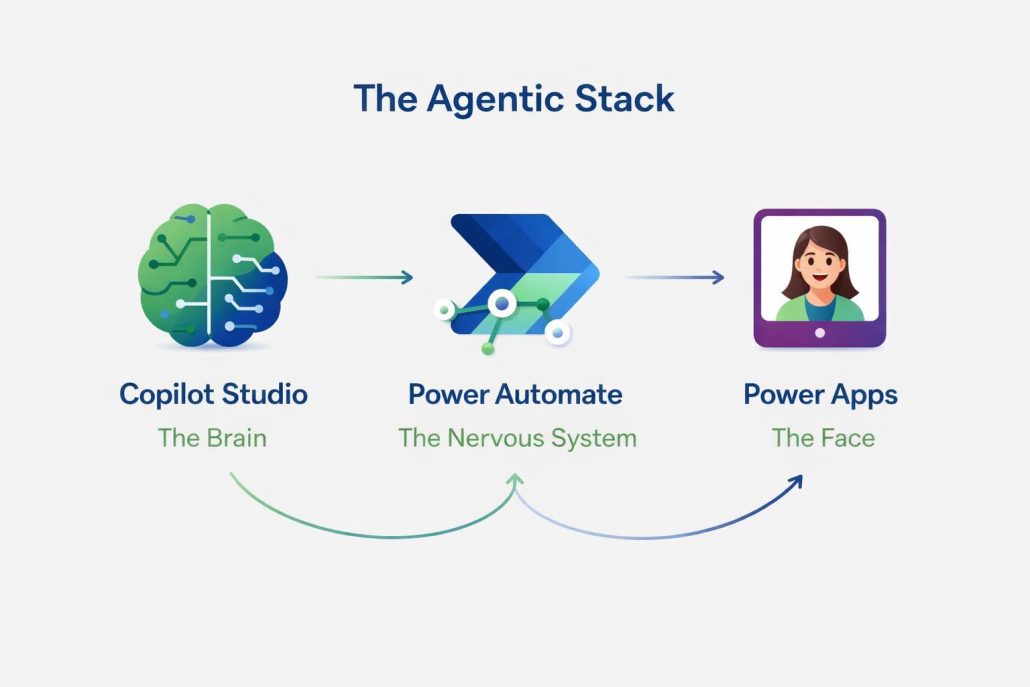
- Microsoft Copilot Studio (The Brain): This is the reasoning engine. It’s where you build intelligent AI agents that can understand what a user wants and decide on the best course of action, rather than just executing a pre-programmed script.
- Power Automate (The Nervous System): This is the workflow orchestrator. It’s the connective tissue that links over 1,000 different applications, from your ERP and CRM to tools like monday.com, allowing them to talk to each other and trigger actions automatically.
- Power Apps (The Face): This is the custom user interface. It allows you to build simple, intuitive apps and portals where your team can interact with data and kick off automated workflows without ever seeing the complexity behind the scenes.
Use Case: Escaping the HR Onboarding Labyrinth
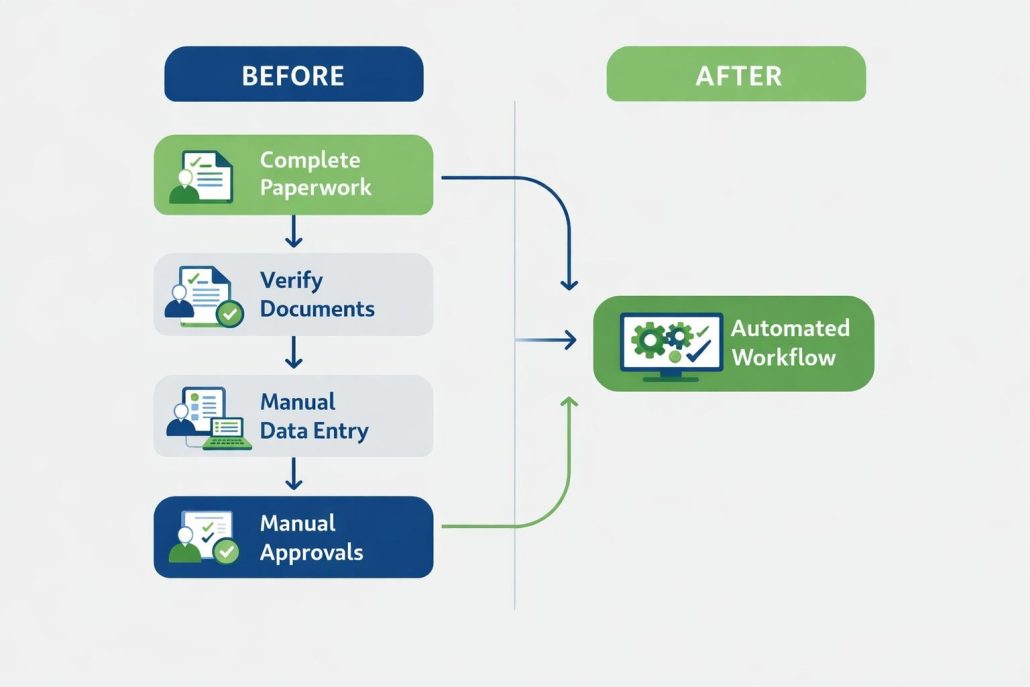
The “Before” Story: In a typical SME, onboarding is a chaotic maze. HR emails a contract, a manager opens a ticket with IT to manually create an email address, and someone in Facilities tries to track a laptop order on a spreadsheet. This fragmented process takes, on average, over 10 hours of manual labor for every single hire. The result? New hires who experience a messy onboarding are twice as likely to start looking for a new job within their first year.
The “Agentic After” Story:
With the Agentic Stack, the process becomes a seamless, intelligent workflow.
- Day Zero Readiness: The moment HR moves a candidate’s status to “Hired” in your HR system, Power Automate triggers a cascade of actions. It automatically creates the user account and email, orders the standard laptop from procurement, and even generates a 30/60/90 day plan for their manager.
- The Onboarding Concierge: On their first day, a new hire can ask an AI agent built in Copilot Studio, “How do I set up my VPN?” The agent instantly verifies their role and permissions and provides them with the correct, step-by-step instructions.
Companies like Epic have automated these very steps, saving over 2,000 hours and an estimated $500,000 annually.
Use Case: Finding Finance’s “Invisible Invoice”
The “Before” Story: This one is personal. At CIT Solutions, we had a dedicated team member who spent 80 hours every month (literally half of their job) manually typing data from vendor invoice PDFs into our NetSuite ERP. It was tedious, prone to human error, and a complete waste of valuable talent.
The “Agentic After” Story:
We turned the person closest to the problem into the solution builder.
- AI Reads the PDF: Using AI Builder and Power Automate, we built a flow where the system now “reads” the invoice PDF. It intelligently extracts the PO number, vendor details, and line items, staging the data for a simple, one-click human “check-off” before committing it to the ERP.
- Smart Guardrails: We then built a simple payment portal in Power Apps. Unlike a spreadsheet that accepts any input, our app uses logic to prevent simple errors. For example, it will block a wire transfer if the user accidentally enters a date in the past, preventing a costly mistake before it can happen.
Use Case: Building a 24/7 Digital Helpdesk for Internal Support
The “Before” Story: IT and HR managers in SMEs are drowning in a sea of repetitive questions. “How do I reset my password?” “What is the guest Wi-Fi?” “How much PTO do I have left?” Answering these questions manually drains time that could be spent on strategic initiatives.
The “Agentic After” Story:
An internal-facing AI agent can become your first line of support.
- The Instant Answer Bot: An internal chatbot built with Copilot Studio can be trained on your company’s handbooks and policies to handle up to 70% of these common inquiries automatically.
- From Helper to Creator: The impact can be profound. At Heineken, their internal “PowerBot” started as a simple tool for summarizing information. It has since evolved into an agent that can help draft project proposals, contributing to an incredible 3.1 million hours of increased productivity across the company.
Glossary of Terms
- Agentic Stack: A set of interconnected low-code and AI tools (like the Microsoft Power Platform) that work together to understand user intent, make decisions, and automate complex business processes.
- Citizen Developer: A non-technical employee who builds applications and automations for their own or their team’s use, leveraging low-code/no-code platforms without formal programming training.
- Low-Code Development: An approach to software development that allows users to create applications through graphical user interfaces and configuration instead of traditional computer programming.
- Center of Excellence (CoE): A dedicated internal team or framework that provides leadership, best practices, support, and governance for a specific technology (like the Power Platform) to ensure it is used effectively and securely across the organization.
How to Start Your Automation Journey
- Identify the Friction: Don’t start with the technology. Start with the pain. Ask your department heads: “What is the most repetitive, low-value task your team spends time on?” Look for processes that involve manual data entry between two or more systems.
- Start Small, Win Fast: Choose one, well-defined process to automate first, like the invoice processing example. A quick, visible win builds momentum and demonstrates the value of the approach to the rest of the organization.
- Empower a Champion: Find a motivated, non-technical employee who deeply understands the business process you want to fix. This person will be your first “Citizen Developer.” Provide them with the training and support to build the solution.
- Establish Guardrails: Before you scale, work with a partner to establish a Center of Excellence (CoE). This involves setting rules for data access, app deployment, and security to ensure you innovate safely.
A Leader’s Framework: How to Talk to Your AI Agents (CRIT)
For the C-Suite, the most important new skill isn’t building the app, it’s clearly defining the problem for the AI. Jeff Woods’ CRIT Framework is a powerful way to structure your prompts for more strategic and useful outputs.
- Context: Why are we doing this? Give the AI the big picture. (e.g., “We are a mid-market manufacturer trying to create a marketing campaign that targets Gen Z consumers.”)
- Role: Who should the AI be? Assigning a persona focuses the response. (e.g., “Act as a skeptical Chief Financial Officer reviewing this plan.”)
- Interview: Ask the AI to ask you questions first. This is a brilliant way to uncover blind spots in your own thinking. (e.g., “Ask me five questions about my target audience that I might not have considered.”)
- Task: What is the exact output you need? Be specific. (e.g., “Based on our conversation, write a 150-word introductory email for this campaign.”)
Governance is the Guardrail, Not the Gate
Empowering everyone to build solutions is the future, but it requires a new approach to governance. The goal isn’t to lock everything down; it’s to provide safe “guardrails” so your team can innovate without creating “Shadow AI” or accidental data leaks.
This is where a Center of Excellence (CoE) becomes critical. At CIT, we help SMEs establish a CoE to manage data policies, provide templates, and oversee security, ensuring your citizen developers are building on a solid, secure foundation.
The ROI is clear: digital leaders see an average return of $2.40 for every $1 spent on their digital adoption efforts. The future of business doesn’t belong to the coders; it belongs to the orchestrators.
Frequently Asked Questions
1. Do my employees need to be developers to use the Microsoft Power Platform?
No. The entire platform is built on low-code/no-code principles. Employees with deep business knowledge but no formal coding experience (“Citizen Developers”) can build powerful applications and automations using drag-and-drop interfaces and simple logic.
2. How do we prevent chaos if everyone starts building their own apps?
This is managed through a Center of Excellence (CoE). A CoE establishes governance, best practices, and security policies. It ensures that while innovation is democratized, it happens within a secure and well-managed framework, preventing data silos or security risks.
3. Is this approach secure for sensitive financial or HR data?
Yes. The Microsoft Power Platform is built on an enterprise-grade security model that inherits the robust security and compliance standards of Microsoft Azure. With a proper CoE, you can define granular permissions and data loss prevention (DLP) policies to control exactly who can access and use sensitive data.
Let’s Build Your “After State”
You’ve seen the “before”: the manual processes, the wasted hours, the frustrated teams. At CIT Solutions, we are passionate about helping SMEs redefine their digital horizon and build their “after state.”
If you’re ready to move from managing bottlenecks to enabling solution builders, let’s have a conversation. We can help you identify your first high-impact automation opportunity and build the governance framework to scale with confidence.
Schedule Your Automation Strategy Consultation Today
Sources
Medium | https://medium.com/@waled.capw/by-2025-citizen-developers-will-outnumber-professionals-4-to-1-is-your-business-ready-ea0005a9492a | Statistic on the 4-to-1 ratio of citizen developers to professional coders by 2025 and context on “Shadow AI.”
Aggranda | https://www.aggranda.com/uipath-london-2025-agentic-automation-is-no-longer-a-concept-its-happening/ | Definition of an agentic engine as one that understands intent and makes decisions.
Zerone Hitech | https://zeronehitech.com/2025/09/power-platform-solutions-for-smes/ | Description of Power Apps as the custom interface for team interaction.
Switchboard | https://www.withswitchboard.com/case-studies/case-study-hr-employee-onboarding-automation | Data point that manual onboarding processes take over 10 hours of labor per hire.
Moveworks | https://www.moveworks.com/us/en/resources/blog/ai-agents-for-onboarding | Statistic that poor onboarding makes new hires 2x more likely to seek a new job and context on AI agents for onboarding questions.
Microsoft Power Platform (YouTube) | https://www.youtube.com/watch?v=qUB6dFd6-JI | Case study of Epic saving 2,000 hours and $500,000 annually through automation.
Teamflect | https://teamflect.com/blog/hr-tech/use-cases-for-ai-agents-in-hr | Statistic that an internal bot can handle up to 70% of common HR/IT inquiries.
Microsoft Customer Stories | https://www.microsoft.com/en-us/customers/story/25909-heineken-microsoft-copilot-studio | Case study of Heineken’s “PowerBot” contributing to 3.1 million hours of increased productivity.
The Fluent Edge Podcast | https://the-fluent-edge-podcast.captivate.fm/episode/what-smart-leaders-do-with-ai | Source for Jeff Woods’ CRIT framework for AI prompting.
CFIB | https://www.cfib-fcei.ca/hubfs/research/reports/2025/SMEs%20Digital%20transformation%20journey-Final-EN-2025%201.pdf | Data on digital leaders seeing a $2.40 ROI for every $1 spent on digital adoption.