The Strategic AI Implementation Roadmap
Why Business Leaders Must Shift from Creation to Validation
Shifting your workforce from creators to validators is the core of a modern AI strategy. Instead of generating materials from scratch, employees use platforms like Microsoft Copilot to draft content, pivoting their focus to quality control, risk mitigation, and high-level strategic alignment.
Many organizations view artificial intelligence as a threat to headcount. However, the true value of a business AI strategy lies in optimization, not replacement. When organizations integrate generative AI tools, they pivot their staff from the time-consuming “creation phase” to the high-value “review and validation stage.”
According to data from Microsoft, the average Copilot user saves 14 minutes per day. More importantly, power users save approximately 6 minutes per prompt when using AI to draft emails, generate presentations, or synthesize data. This efficiency allows key personnel to focus on their core expertise rather than administrative friction.
The 5-Step AI Implementation Roadmap for Modern Organizations
A successful AI implementation roadmap requires a structured, phased approach: identifying operational bottlenecks, securing data environments, appointing internal governance leaders, selecting enterprise-grade tools, and launching a measured 90-day pilot study to calculate clear return on investment.
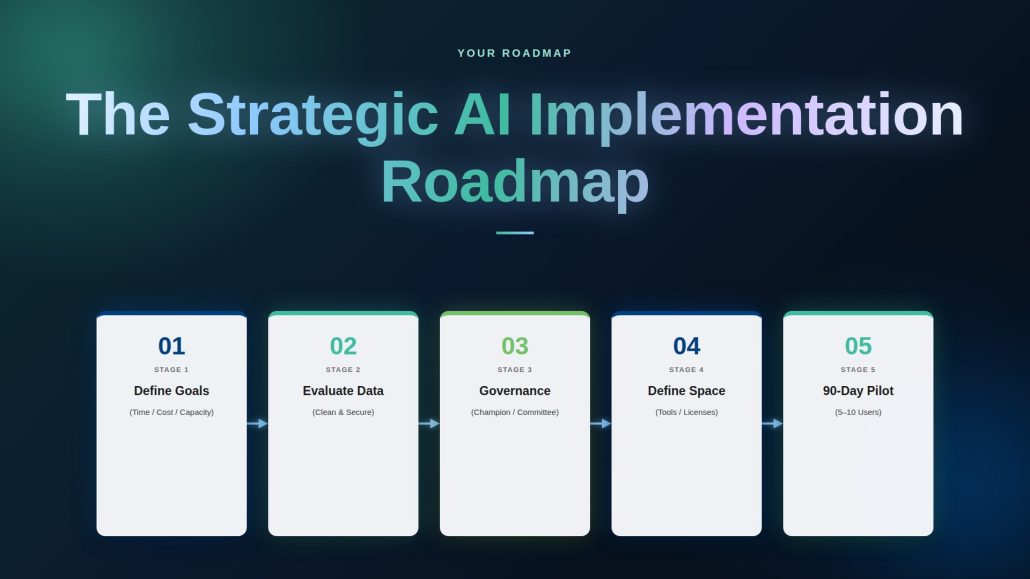
During CIT’s AI Strategy Capstone session, Matthew, CIT’s Fractional Chief AI Officer, outlined a comprehensive framework designed to take organizations from AI curiosity to operational excellence.
Step 1: Define Your Goals (Where Does Time Go?)
Before purchasing software licenses, identify your operational bottlenecks. Focus on three core vectors:
- Time Sinks: What repetitive tasks occupy your most expensive employees? For example, project managers often spend hours coordinating schedules across disparate systems—a task easily handled by automated agents.
- Cost Centers: Where does human error actively cost your business money? An AI can act as a validation layer to catch data-entry discrepancies.
- Capacity Constraints: Which processes prevent your team from taking on 20% to 30% more work?
Step 2: Evaluate and Clean Your Data
AI cannot perform effectively with disorganized or outdated data. If your organization migrated CRM systems three years ago, an unconfigured AI tool may pull obsolete client records.
- Data Hygiene: Archive legacy files that are no longer relevant to daily operations.
- Access Control: Ensure that employees can only access the files necessary for their roles. Implement identity access management reviews with platforms like Okta to verify permissions.
- Sensitivity Labeling: Tag confidential documents to prevent AI engines from indexing board meeting minutes or proprietary financial records.
Step 3: Establish Governance (The AI Champion and Steering Committee)
Governance ensures your AI strategy aligns with organizational compliance and risk tolerance.
- The AI Champion: Appoint a director-level executive or higher to take official ownership of the AI roadmap. This individual does not need to be highly technical, but they must possess the authority to make cross-departmental strategic decisions.
- The AI Steering Committee: Build a diverse committee featuring at least one representative from every department. This group acts as an enabling body, reviewing use cases, updating internal AI policies, and aligning tools with departmental workflows.
Step 4: Define Your Tool Space
Select the specific platforms that fit your security posture and operational needs. While Microsoft Copilot is the standard choice for organizations embedded in the Microsoft 365 ecosystem, other specialized tools like Anthropic Claude or OpenAI’s ChatGPT Enterprise may suit developer-centric or creative workflows.
Ensure your security team uses robust endpoint protection and application control software, such as Threatlocker, to block unauthorized “shadow AI” applications while permitting approved corporate platforms.
Step 5: Launch a 90-Day AI Pilot Study
Do not roll out AI to the entire company at once. Start with a small, focused pilot study:
- Participant Selection: Choose 5 to 10 early adopters who are enthusiastic about technology.
- Baseline Measurement: Have participants document how much time they spend on specific tasks before using AI.
- The 90-Day Window: Give the team room to experiment, make mistakes, and discover optimal prompting workflows.
- ROI Evaluation: At the end of 90 days, analyze the time saved and determine if the pilot should be expanded.
Overcoming the Cultural Friction of AI Adoption
Overcoming cultural resistance to AI requires transparent leadership and psychological safety. By positioning AI as an optimization tool rather than a replacement strategy, organizations can address employee anxieties, highlight early efficiency wins, and foster collaborative prompt-sharing networks.
Resistance to technological change is natural. When employees hear about AI implementation, their immediate concern is often job security. To build a successful AI-first culture, leadership must address these anxieties directly.
- Lead from the Top: The executive leadership team must actively champion the initiative, demonstrating that AI adoption is a strategic priority.
- Ensure Psychological Safety: Guarantee that the goal of AI integration is to remove administrative burdens, allowing employees to focus on creative, strategic, and client-facing work.
- Provide a Secure Environment: Educate employees that enterprise-grade tools protect data privacy. For example, Microsoft Copilot Chat operates within your secure tenant, meaning your proprietary data is never used to train public models.
- Highlight Visible Wins: When a pilot participant automates a tedious reporting process, share that success story across the organization. This encourages other team members to explore how AI can simplify their own workflows.
Take the Next Step
Building an enterprise-grade AI strategy requires balancing security, data compliance, and change management. CIT provides the consulting expertise and technical support needed to navigate this transition smoothly.
Whether you want to integrate Microsoft Copilot, deploy Anthropic Claude, or build custom automated agents, CIT is here to guide your journey.
Ready to transform your business operations? Check out our webinar series here