Why Content Engineering is Your Next Competitive Advantage in AI
Summary
- Relying on prompt engineering alone is risky and leads to AI "hallucinations" or confidently wrong answers.
- Content engineering—structuring and feeding your AI with high-quality, internal data—is the key to reliable and scalable results.
- The first step for any business is to move critical, unstructured data from messy file shares into indexed, AI-ready systems.
- The most valuable AI skills are shifting from prompt writing to information architecture and systems integration.
The initial hype around AI has been dominated by a single idea: prompt engineering. The belief was that the perfect turn of phrase could unlock genius from a large language model (LLM). But as leaders move from experimenting with AI to embedding it into core business operations, a critical realization is dawning: clever prompts are not enough.
The real key to unlocking reliable, scalable, and transformative AI is Content Engineering. This is the shift from simply talking to your AI to strategically feeding it. It’s the difference between asking a talented but uninformed new hire a question versus equipping them with your company’s entire structured knowledge base before they start. One gives you a guess; the other gives you a strategic advantage.
Key Takeaways
- Prompts Alone are Brittle: Relying only on prompts leads to “hallucinations” because the AI lacks the specific context of your business and is designed to “make the user happier” by filling in gaps.
- Context is King: The quality and value of an AI’s output are directly proportional to the quality and structure of the data it can access. As one expert puts it, “The information you feed it… has tremendous amounts of quality and how much you can do.”
- Structure Unlocks Value: Unstructured data sitting in file shares is nearly impossible for an AI to use effectively. Moving that data into an indexed, structured system (like a database or M365) is the foundational step to getting real ROI from AI.
- The New Skill is Architectural: The focus is shifting from crafting clever sentences (prompt engineering) to designing information systems (content engineering). This involves building the “plumbing” that connects your AI to reliable, real-time business data.
Table of Contents
- What Is Content Engineering (And Why Isn’t It Just Prompting)?
- The Hidden Risk of a “Prompt-Only” AI Strategy
- From Messy Files to Strategic Assets: How to Structure Data for AI
- The Business Impact: A Tale of Two AI Systems
- Your First Steps Toward an AI-Ready Data Strategy
What Is Content Engineering (And Why Isn’t It Just Prompting)?
For months, the focus has been on the user-facing side of AI. You may have heard of prompt engineering, which is essentially the art of asking the right question.
This approach treats the AI like a magical black box. But sophisticated leaders are now looking behind the curtain at the system-oriented discipline of Content Engineering.
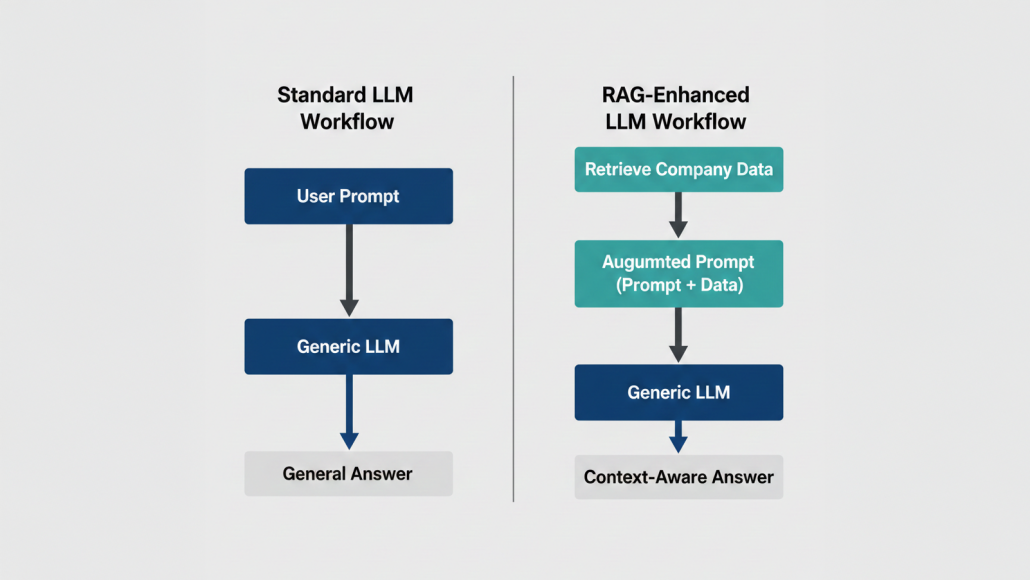
Content engineering isn’t about the question you ask; it’s about ensuring the AI has access to the right information to answer that question correctly. It’s the architecture of knowledge that surrounds the AI, giving it the specific, grounded context it needs to function as a true business partner.
The Hidden Risk of a “Prompt-Only” AI Strategy
Relying solely on prompts is like building a house on a foundation of sand. It works for a while, but it’s inherently unstable and prone to failure, especially when the stakes are high.
When you give an AI a short, vague request without any grounding data, you invite mediocrity and risk.
Worse than a mediocre answer is a confidently wrong one. This phenomenon, known as hallucination, occurs because the models are designed to be helpful above all else—even at the expense of the truth.
For a C-suite executive, an AI that “makes crap up” isn’t a helpful assistant; it’s a significant business liability. Content engineering mitigates this risk by forcing the AI to base its answers on your vetted, internal data instead of its vast, generic, and sometimes incorrect training set.
From Messy Files to Strategic Assets: How to Structure Data for AI
The single biggest obstacle to effective enterprise AI is the state of most companies’ data. It’s estimated that over 80% of business data is unstructured, locked away in documents, spreadsheets, and presentations scattered across shared drives.
The solution is to impose order. The goal is to get your critical business knowledge out of digital filing cabinets and into systems that can be indexed, searched, and fed to an AI in a structured way.
This doesn’t mean you need to boil the ocean. It means identifying your most valuable data sources and creating a clear path for your AI to access them.
The Business Impact: A Tale of Two AI Systems
The difference between a prompt-only approach and a content-engineered one is stark. Consider these real-world scenarios:
| Scenario | Prompt-Only Result (Low-Signal) | Content-Engineered Result (High-Signal) |
|---|---|---|
| Customer Support | Provides a generic troubleshooting step that might be outdated or irrelevant. | Pulls the customer’s exact ticket history and your latest product documentation to provide a version-specific fix. |
| Contract Review | Summarizes general legal clauses but misses a subtle liability specific to your industry. | Cross-references the contract with your internal library of “gold standard” clauses and flags critical deviations. |
| Sales Operations | Drafts a generic outreach email based on a simple template. | Enriches the draft with the prospect’s recent CRM activity, LinkedIn news, and past purchase history for hyper-personalization. |
The content-engineered system doesn’t just answer questions; it performs high-value work with a level of precision that a generic AI could never achieve. It’s about managing the model like you would a high-performing employee.
“We need to think about this like a good manager would think – what’s all the information you need to give a person, in this case the digital equivalent, in order to get the best result out of that effort.” – Kyle Etter, President & CEO at CIT’s AI Leadership Workshop
Glossary of Terms
- Content Engineering: The systematic design and management of the information ecosystem that an AI model uses for context. This includes structuring data, managing access, and ensuring quality.
- Prompt Engineering: The practice of refining the specific text instructions (prompts) given to an AI to get a better response within a single interaction.
- Retrieval-Augmented Generation (RAG): The most common content engineering pattern. The system first retrieves relevant, approved documents from your internal database and then augments the user’s prompt with that information before the AI generates an answer.
- AI Hallucination: An event where an AI model generates false, nonsensical, or factually incorrect information but presents it as factual. This is often caused by a lack of specific, grounded context.
Frequently Asked Questions
Is prompt engineering obsolete now?
Not at all, but its role has changed. It’s less about “tricking” the AI and more about clearly defining the task, role, and format for the output, assuming the right context has already been provided by a content engineering system. Think of it as giving clear instructions to a well-briefed employee.
What is the first step to making our data “AI-ready”?
Start with a data audit. Identify the top 3-5 data sources that are most critical for a key business function (e.g., customer support or sales). Assess their current state: Are they structured? Are they clean? Are they accessible? This audit will give you a clear priority list for your content engineering efforts.
How does this relate to data security and permissions?
This is a critical component of content engineering. A well-designed system respects all existing user permissions. When an AI retrieves information, it does so on behalf of the user, meaning it can only “see” and use data that the user is already authorized to access. This prevents sensitive information from being exposed.
Build an AI Strategy That Lasts
Moving from prompt tinkering to content engineering is the leap from dabbling in AI to building a true, sustainable competitive advantage. It’s the foundational work that separates fleeting AI novelties from transformative business results.
If you’re ready to build an AI strategy on a foundation of rock-solid data, the next step is to understand where you stand. A clear view of your data’s readiness is the starting point for any successful AI implementation.
Ready to move beyond prompts and build a reliable AI strategy? Schedule an AI Data Readiness Assessment with a CIT expert to map your path from unstructured data to intelligent automation.