Zero Trust, Total Protection: How AI Enables the Future of Access Security
The Evolution of Access Security: From Static to AI-Driven
The landscape of access security has undergone a dramatic transformation in recent years, shifting from static, rule-based systems to dynamic, AI-driven solutions. This evolution has been driven by the increasing sophistication of cyber threats and the growing complexity of modern IT environments.
Traditional access control methods relied heavily on predefined rules and policies, often implemented through firewalls and simple authentication mechanisms. While effective against basic threats, these static defenses proved inadequate in the face of evolving cybercrime tactics. Attackers began exploiting the rigid nature of these systems, finding ways to circumvent fixed rules and gain unauthorized access.
As cyber threats grew in complexity and scale, the need for a more dynamic and intelligent defense became apparent. Enter artificial intelligence and machine learning technologies, which have revolutionized the approach to access security. AI-powered solutions can analyze vast amounts of data in real-time, identifying subtle patterns and anomalies that would be impossible for human analysts to detect.
This transition to AI-driven security addresses several key limitations of traditional methods:
- Adaptability: AI systems can continuously learn and adjust to new threat patterns, providing a more flexible defense against evolving attacks.
- Speed: With the ability to process data and make decisions in milliseconds, AI can respond to threats far faster than human operators.
- Scalability: As networks grow more complex, AI can manage and monitor an ever-increasing number of access points and user behaviors.
- Contextual awareness: AI can consider multiple factors simultaneously, making more nuanced access decisions based on user behavior, device status, and environmental context.
The rise of sophisticated, AI-powered cyber attacks has further necessitated the adoption of equally advanced defensive measures. Cybercriminals now leverage machine learning to automate attacks, evade detection, and exploit vulnerabilities at unprecedented speeds. This has created an “AI vs. AI” dynamic in the cybersecurity realm, where defensive AI must constantly evolve to stay ahead of malicious AI.
As organizations increasingly adopt cloud services, IoT devices, and remote work policies, the traditional network perimeter has dissolved. This new reality demands a more intelligent approach to access control, one that can secure a distributed and ever-changing IT landscape. AI-driven security solutions are uniquely positioned to meet this challenge, offering the flexibility and intelligence needed to protect modern digital environments.
The evolution from static to AI-driven access security represents more than just a technological upgrade; it’s a fundamental shift in how we approach cybersecurity. By embracing AI, organizations can move from a reactive stance to a proactive, predictive security posture, better equipped to face the challenges of an increasingly complex digital world.
Core AI Applications in Identity and Access Management
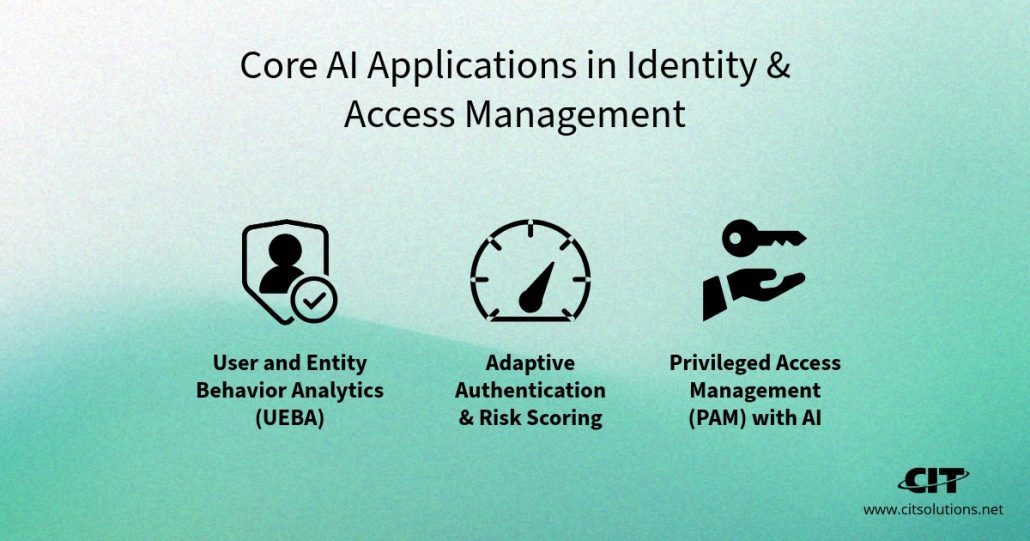
Artificial Intelligence has revolutionized Identity and Access Management (IAM), introducing sophisticated capabilities that far surpass traditional security measures. At the forefront of this transformation are several key applications that leverage AI to enhance security, streamline operations, and provide dynamic, context-aware access control.
User and Entity Behavior Analytics (UEBA)
UEBA systems employ advanced AI and machine learning techniques to continuously monitor an organization’s network. These systems analyze activities related to both human users and non-human entities, such as servers and devices, to detect potential security threats. The core principle of UEBA involves establishing “typical” behavioral patterns for all users and entities within the organization. Once these baselines are set, the system can effectively flag any abnormal patterns of activity.
UEBA gathers comprehensive data in real-time from diverse sources, including system logs, network traffic data, application usage metrics, and user activity logs. This rich dataset is crucial for accurately establishing and refining behavioral baselines. The system maintains continuous, real-time monitoring of the network, immediately flagging deviations from the established norm as anomalies. For instance, it might detect a privileged user attempting to access critical systems outside of regular business hours or a login attempt from an unusual geographical location.
Adaptive Authentication and Risk Scoring
Adaptive authentication represents a significant advancement in access security. It uses AI and machine learning to analyze real-time trends, identify suspicious activity, and dynamically adjust the authentication factors required for a user in a specific situation. This system can automatically step up or step down authentication requirements based on perceived risk.
Risk scoring employs a data-driven risk engine to assess the likelihood that a sign-in event represents malicious activity. This evaluation considers various real-time parameters, including the IP address used, the user’s behavioral information, and historical sign-in attempts. For example, if a user’s sign-in location is geographically implausible (e.g., sudden travel across continents), it is flagged as risky. Similarly, sign-ins from anonymous IP addresses or infected devices are considered high-risk events.
These systems assign risk scores to suspicious events and adjust authentication factors in real-time based on predefined policies. A low-risk behavior might only require a username and password, while a high-risk behavior could result in access denial or require additional verification steps.
Privileged Access Management (PAM) with AI
AI is transforming Privileged Access Management by enhancing both security and operational efficiency. AI-powered PAM systems analyze user behavior, detect anomalies, and identify potential security threats in real-time, enabling swift responses to prevent unauthorized access to sensitive data and systems.
A key strength of AI in PAM is its ability to detect abnormal behavior patterns among privileged users. By analyzing user activity and access patterns, AI algorithms can flag suspicious actions in real-time, such as sudden access to critical systems during non-business hours or unusual login locations.
AI-driven risk assessment in PAM dynamically adjusts access permissions based on perceived risk levels, considering factors like user behavior, device information, and contextual data. This adaptive approach ensures sensitive resources remain protected without unnecessarily impeding legitimate user activities.
Furthermore, predictive analytics capabilities enable PAM solutions to anticipate and mitigate security threats before they escalate. By analyzing historical data and monitoring user behavior in real-time, AI models can identify potential vulnerabilities and security incidents, including compromised credentials or insider threats.
In the event of a security incident, AI-driven automation plays a crucial role by orchestrating timely and effective responses. Upon identifying suspicious activity, AI-powered PAM systems can automatically initiate predefined actions like denying access, alerting administrators, or terminating active sessions, minimizing manual intervention and accelerating incident resolution.
AI-Powered User and Entity Behavior Analytics (UEBA)

User and Entity Behavior Analytics (UEBA) represents a significant leap forward in cybersecurity, leveraging artificial intelligence to monitor and protect digital environments with unprecedented precision. At its core, UEBA systems employ advanced machine learning algorithms to analyze patterns of behavior across an organization’s network, establishing a nuanced understanding of what constitutes “normal” activity for both human users and non-human entities like servers and IoT devices.
Continuous Monitoring
UEBA systems operate on a 24/7 basis, continuously ingesting and analyzing vast amounts of data from diverse sources across the network. This includes system logs, network traffic data, application usage metrics, and detailed user activity logs. The AI algorithms process this information in real-time, allowing for immediate detection of potential security threats as they emerge.
Establishing Behavioral Baselines
One of the key strengths of AI-powered UEBA is its ability to create sophisticated behavioral baselines for each user and entity within the network. These baselines are not static; instead, they evolve over time as the AI learns and adapts to changing patterns of legitimate behavior. This dynamic approach allows the system to account for natural variations in user activity, such as changes in work patterns or responsibilities, while still maintaining a high level of security.
Real-time Anomaly Detection
With established baselines in place, UEBA systems can swiftly identify deviations from normal behavior patterns. This might include unusual login times, access attempts from unfamiliar locations, unexpected file transfers, or sudden changes in system configurations. When anomalies are detected, the system can trigger alerts for further investigation or, in cases of high-risk activities, automatically initiate predefined security protocols to mitigate potential threats.
Benefits and Challenges
The benefits of AI-powered UEBA are substantial. These systems can detect subtle, complex threats that might easily evade traditional rule-based security measures. They significantly enhance an organization’s ability to identify insider threats, compromised accounts, and advanced persistent threats (APTs). Moreover, by automating much of the monitoring and initial analysis process, UEBA reduces the workload on human security teams, allowing them to focus on high-level strategy and complex investigations.
However, implementing UEBA is not without challenges. The effectiveness of these systems is heavily dependent on the quality and comprehensiveness of the data they analyze. Organizations must ensure they have robust data collection and integration processes in place. Privacy concerns can also arise, as UEBA systems require extensive monitoring of user activities. Striking the right balance between security and privacy is crucial. Additionally, while AI significantly reduces false positives compared to traditional methods, fine-tuning the system to minimize both false positives and false negatives requires ongoing attention and expertise.
Despite these challenges, the power of AI-driven UEBA to enhance an organization’s security posture is undeniable. As cyber threats continue to evolve in sophistication, UEBA represents a critical tool in the modern cybersecurity arsenal, providing dynamic, intelligent protection against a wide range of potential threats.
Adaptive Authentication and Dynamic Risk Scoring
Adaptive authentication and dynamic risk scoring represent a significant leap forward in access security, leveraging the power of AI and machine learning to provide real-time, context-aware access decisions. This approach moves beyond traditional static authentication methods, offering a more nuanced and responsive security posture.
Real-time Risk Assessment
At the core of adaptive authentication is the ability to perform real-time risk assessments. AI models continuously analyze various factors such as user behavior, device information, location data, and network characteristics. This ongoing analysis allows the system to detect anomalies and potential threats as they occur, rather than relying on predetermined rules or periodic reviews.
For instance, if a user attempts to log in from an unfamiliar location or at an unusual time, the system can immediately flag this as a potential risk. Similarly, if a series of failed login attempts is detected, the risk score for that account can be dynamically adjusted upward.
Contextual Authentication Factors
Adaptive authentication systems use AI to determine the most appropriate authentication factors based on the current context. This might include:
- Location-based factors: Requiring additional verification if a login attempt comes from an unusual geographic location.
- Device-based factors: Adjusting authentication requirements based on whether the device is recognized and trusted.
- Behavior-based factors: Analyzing typing patterns, mouse movements, or application usage to verify user identity.
- Time-based factors: Increasing scrutiny for access attempts outside of normal working hours.
By considering these contextual factors, the system can step up or step down authentication requirements in real-time, balancing security with user convenience.
Continuous Authentication
Unlike traditional authentication methods that verify identity only at the point of login, adaptive systems perform continuous authentication throughout a user’s session. This involves ongoing monitoring of user behavior and environmental factors to ensure the authenticated user remains the one in control of the session.
For example, if a user’s behavior suddenly changes mid-session – such as attempting to access sensitive data they don’t normally interact with – the system can prompt for re-authentication or even automatically terminate the session.
Examples of Risk Scoring Models
Risk scoring models use AI and machine learning algorithms to assign numerical scores to various access attempts, indicating the level of risk associated with each. Here are some examples:
- Behavioral Anomaly Scoring: This model compares current user actions against their historical behavior patterns, assigning higher risk scores to significant deviations.
- Multi-Factor Risk Aggregation: Combines scores from multiple risk factors (location, device, time, etc.) to produce an overall risk score for each access attempt.
- Peer Group Analysis: Compares a user’s behavior to that of their peers in similar roles, flagging unusual activity that deviates from the norm.
- Machine Learning-Based Prediction: Uses historical data to train models that can predict the likelihood of a security incident based on current access patterns.
These risk scoring models enable organizations to implement granular, risk-based access policies. For instance, a low-risk score might only require a simple password, while a high-risk score could trigger multi-factor authentication or even block access entirely pending human review.
By leveraging AI for adaptive authentication and dynamic risk scoring, organizations can significantly enhance their security posture, reducing the risk of unauthorized access while maintaining a smooth user experience for legitimate activities.
AI in Privileged Access Management (PAM)

Artificial Intelligence is revolutionizing Privileged Access Management (PAM) by introducing unprecedented levels of security and operational efficiency. AI-powered PAM systems are transforming how organizations protect their most sensitive assets and critical systems.
Real-time Threat Detection
AI algorithms excel at analyzing vast amounts of user behavior data in real-time, detecting subtle anomalies that would be imperceptible to human analysts. These systems continuously monitor privileged user activities, instantly flagging suspicious actions such as unusual login times, unexpected access to critical systems, or abnormal data transfer patterns. This real-time vigilance significantly reduces the window of opportunity for potential attackers, allowing for immediate intervention before breaches can occur.
Dynamic Permission Adjustment
AI-driven PAM solutions implement adaptive access controls that dynamically adjust user permissions based on real-time risk assessments. By considering factors such as user behavior, device information, network location, and time of access, these systems can automatically elevate or restrict privileges as needed. This dynamic approach ensures that users always have the minimum necessary access to perform their tasks, adhering to the principle of least privilege while maintaining operational efficiency.
Predictive Analytics
Leveraging machine learning models, AI-enhanced PAM systems can predict potential security threats before they materialize. By analyzing historical data patterns and current user behaviors, these predictive capabilities allow organizations to proactively address vulnerabilities and potential insider threats. For instance, the system might forecast an increased risk of credential compromise based on subtle changes in a user’s access patterns, prompting preemptive security measures.
Automated Incident Response
When security incidents do occur, AI-powered PAM systems can orchestrate rapid, automated responses. Upon detecting suspicious activity, these systems can instantly initiate predefined actions such as revoking access, isolating affected systems, or triggering additional authentication challenges. This automated response capability significantly reduces the mean time to detect (MTTD) and mean time to respond (MTTR) to security incidents, minimizing potential damage and data loss.
By integrating these AI-driven capabilities, PAM solutions are not only enhancing security but also streamlining operations and reducing the burden on IT and security teams. As threats continue to evolve in sophistication, AI in PAM will play an increasingly crucial role in safeguarding organizations’ most critical assets and maintaining robust cybersecurity postures.
Network Access Control (NAC) Enhanced by AI
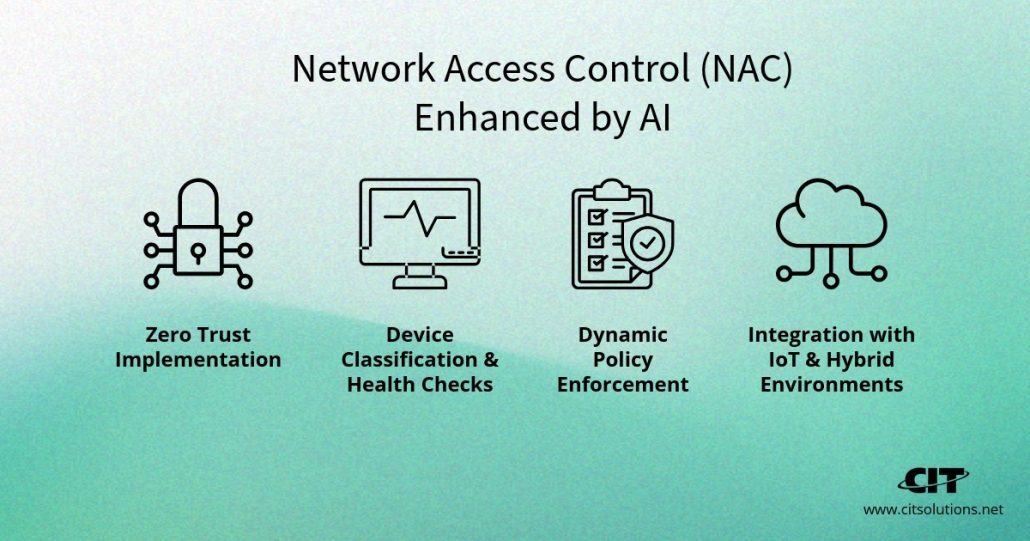
Artificial Intelligence is revolutionizing Network Access Control (NAC), transforming it into a cornerstone of modern cybersecurity strategies. AI-powered NAC solutions are crucial for implementing and maintaining robust Zero Trust architectures, especially in complex hybrid IT, operational technology (OT), and Internet of Things (IoT) environments where traditional security tools often fall short.
Zero Trust Implementation
AI-enhanced NAC systems are at the forefront of Zero Trust implementation, enforcing the principle of “never trust, always verify” at every network access point. These systems continuously authenticate and authorize users and devices, ensuring that trust is never assumed and access is granted based on real-time verification of multiple factors. AI algorithms analyze vast amounts of contextual data to make split-second decisions on access rights, significantly reducing the risk of unauthorized entry.
Device Classification and Health Checks
One of the most powerful applications of AI in NAC is in device classification and health assessment. AI-driven systems can accurately identify and categorize devices connecting to the network, even as the diversity of endpoints continues to grow. These systems perform real-time health checks, assessing factors such as patch levels, antivirus status, and compliance with security policies. AI algorithms can detect subtle anomalies that might indicate a compromised device, enabling proactive quarantine or remediation before it can pose a threat to the network.
Dynamic Policy Enforcement
AI enables NAC solutions to move beyond static, rule-based policies to dynamic, context-aware policy enforcement. By continuously analyzing user behavior, device characteristics, and network conditions, AI-powered NAC can adjust access privileges in real-time. This might involve stepping up authentication requirements, restricting access to sensitive resources, or even isolating a device if suspicious activity is detected. Such dynamic enforcement ensures that security policies remain effective in the face of evolving threats and changing network conditions.
Integration with IoT and Hybrid Environments
As organizations increasingly adopt IoT devices and hybrid cloud environments, NAC solutions must adapt to manage a more diverse and distributed network landscape. AI is key to this adaptation, enabling NAC systems to effectively monitor and control access across a wide range of devices and environments. In IoT scenarios, AI can help identify and secure devices that may lack traditional security features. For hybrid environments, AI-enhanced NAC provides consistent policy enforcement across on-premises, cloud, and edge computing resources, ensuring a unified security posture regardless of where data and applications reside.
By leveraging AI, modern NAC solutions are not just controlling access but are becoming intelligent guardians of network integrity. They provide organizations with unprecedented visibility, control, and adaptability in managing network access, forming a critical line of defense in today’s complex and ever-evolving threat landscape.
AI’s Role in Password Management and Security Training
Artificial Intelligence is revolutionizing password management and security awareness training, offering unprecedented levels of protection and personalization. In the realm of password management, AI-driven threat detection is becoming increasingly sophisticated, providing real-time protection against emerging threats.
AI-Driven Threat Detection in Password Managers
Modern password managers are leveraging AI to identify and mitigate phishing attacks, one of the most common vectors for credential theft. These systems use machine learning algorithms to analyze login attempts, flagging suspicious activities that deviate from established user patterns. For instance, if a user typically logs in from a specific geographic location during certain hours, an attempt from an unusual location or at an odd time would trigger additional security measures.
AI-powered password managers also offer adaptive authentication, which dynamically adjusts the level of authentication required based on the perceived risk of each login attempt. This might involve prompting for additional verification steps, such as biometric authentication or a security question, when the AI detects potentially suspicious activity.
Personalized Security Awareness Training
AI is transforming security awareness training from a one-size-fits-all approach to a highly personalized experience. Machine learning algorithms analyze individual user behavior, performance in simulated phishing tests, and other metrics to create tailored training programs. These AI systems can identify specific areas where each user needs improvement and recommend relevant training modules.
For example, if a user consistently falls for a particular type of phishing email, the AI might suggest targeted training on recognizing that specific threat. This personalized approach ensures that training resources are used efficiently, focusing on each user’s unique vulnerabilities and learning needs.
Automated Risk Assessment and Remediation
AI systems are now capable of conducting continuous, automated risk assessments across an organization’s user base. These assessments take into account factors such as password strength, multi-factor authentication usage, and susceptibility to phishing attacks. Based on these assessments, AI can automatically trigger remediation actions, such as forcing a password change for high-risk accounts or initiating additional security training for vulnerable users.
Furthermore, AI-powered systems can proactively monitor for compromised credentials on the dark web. If a user’s credentials are found in a data breach, the system can automatically alert the user and initiate the password reset process, significantly reducing the window of vulnerability.
By automating these processes, organizations can maintain a robust security posture with minimal manual intervention, allowing security teams to focus on more complex threats and strategic initiatives.

ThreatLocker: AI-Powered Zero Trust and Threat Detection
ThreatLocker stands at the forefront of AI-driven cybersecurity, offering a comprehensive suite of tools that leverage artificial intelligence to implement a robust Zero Trust architecture and advanced threat detection capabilities. At the core of ThreatLocker’s approach is the integration of AI with innovative security concepts like Allowlisting and Ringfencing™, which work in tandem to create a formidable defense against modern cyber threats.
The Allowlisting feature, enhanced by AI, moves beyond traditional blacklisting approaches. Instead of trying to identify and block known threats, Allowlisting creates a whitelist of approved applications and processes. AI algorithms continuously analyze and update this list, ensuring that only verified and trusted software can execute within the protected environment. This proactive stance significantly reduces the attack surface and mitigates the risk of zero-day exploits.
Complementing Allowlisting is ThreatLocker’s Ringfencing™ technology. This AI-powered feature creates virtual boundaries around applications, controlling how they interact with the system and other applications. By leveraging machine learning, Ringfencing™ can dynamically adjust these boundaries based on observed behavior patterns, preventing lateral movement of threats and containing potential breaches.
ThreatLocker’s Identity Threat Detection and Response (ITDR) solution represents a leap forward in access security. Utilizing advanced AI and machine learning algorithms, ITDR continuously monitors user activities, authentication patterns, and access logs. This enables the system to establish baseline behaviors for each user and quickly identify anomalies that may indicate compromised credentials or insider threats. The AI can detect subtle changes in user behavior, such as unusual login times, unexpected privilege escalations, or access attempts from new locations, triggering immediate alerts or automated responses.
The company’s AI-driven Endpoint Detection and Response (EDR) capabilities further enhance its security offerings. ThreatLocker Detect leverages artificial intelligence to analyze vast amounts of telemetry data from endpoints, network traffic, and system logs. This AI-powered analysis allows for the rapid identification of potential threats, including sophisticated attacks that might evade traditional signature-based detection methods. The system can automatically correlate seemingly disparate events across multiple endpoints to uncover coordinated attack campaigns.
Moreover, ThreatLocker’s AI algorithms continuously learn from new threat data and attack patterns, allowing the system to evolve and adapt to emerging cybersecurity challenges. This self-improving capability ensures that the protection remains effective against the latest threats, including those leveraging AI for evasion tactics.
By combining these AI-powered features – Allowlisting, Ringfencing™, ITDR, and EDR – ThreatLocker provides a holistic, intelligent security solution. This integrated approach not only detects and responds to threats more effectively but also proactively prevents many attacks from gaining a foothold in the first place, embodying the principles of Zero Trust security in an AI-driven framework.
Kaseya: AI Innovations in IT Management and Cybersecurity
Kaseya has made significant strides in integrating AI into their IT management and cybersecurity solutions, with a particular focus on enhancing identity validation, secure access, and Zero Trust implementation. Their Spring 2025 release showcases a range of AI-driven innovations designed to bolster security and streamline IT operations for managed service providers (MSPs) and their clients.
AI-Driven Identity Validation
At the forefront of Kaseya’s AI initiatives is the Kaseya 365 Identity Validation system. This cutting-edge solution leverages machine learning algorithms to ensure that only legitimate users and devices can access SaaS systems. The system’s AI engine automatically links user identities with recognized devices, simplifying the identity validation process while maintaining rigorous access controls. By continuously monitoring login behaviors and session patterns, the AI can swiftly detect and respond to suspicious access attempts, triggering automated alerts and rapid responses to potential identity breaches without the need for human intervention.
Secure Access and Zero Trust Implementation
Datto Secure Edge, a key component of Kaseya’s security portfolio, delivers secure access and Zero Trust principles at scale. The platform emphasizes thorough identity verification, device posture checks, and least privilege access before granting users or machines access to corporate resources. While the specific AI mechanisms within Secure Edge are not explicitly detailed, the platform’s ability to enforce dynamic, context-aware access policies aligns with advanced AI-driven security paradigms. This approach enables organizations to maintain a robust security posture across distributed networks and cloud environments.
SonicWall AI for Monitoring & Insight (SAMI)
A standout feature in Kaseya’s AI arsenal is the integration of SonicWall AI for Monitoring & Insight (SAMI). This embedded AI and automation tool is designed to streamline management, accelerate issue resolution, and reduce alert fatigue for MSPs. SAMI’s conversational AI interface allows technicians to interact through messaging platforms, providing instant answers and performing tasks without directly logging into firewall applications. The AI system can evaluate firewall security, analyze user and network activities, and retrieve threat detection information. SAMI’s capabilities extend to verifying firewall status, configuration, security services, and redundancy setup, making it a powerful ally for MSPs managing complex security infrastructures.
By incorporating these AI-driven solutions, Kaseya is positioning itself at the forefront of intelligent cybersecurity and IT management. The company’s focus on AI-enhanced identity validation, secure access controls, and intuitive monitoring tools demonstrates a commitment to leveraging artificial intelligence to address the evolving challenges in the cybersecurity landscape. As threats become more sophisticated and IT environments more complex, the role of AI in Kaseya’s offerings is likely to expand, providing MSPs and their clients with increasingly powerful tools to protect and manage their digital assets.

Scale Computing: AI-Driven Edge Security
Scale Computing has positioned itself at the forefront of AI-driven edge security through its strategic collaboration with AI EdgeLabs. This partnership has resulted in a comprehensive solution that addresses the unique challenges of securing distributed edge deployments. By leveraging artificial intelligence, Scale Computing offers a holistic approach to edge computing security that ensures uninterrupted operation and efficient management across diverse environments.
A key feature of this collaboration is the implementation of early threat detection capabilities specifically tailored for edge environments. The AI-powered system continuously monitors edge infrastructures, allowing for immediate response to ongoing attacks and minimizing potential damage. This proactive approach is crucial in edge computing scenarios where traditional security measures may fall short due to the distributed nature of resources and potential network limitations.
Scale Computing’s platform enforces Zero Trust security principles, which is particularly important in edge computing where the attack surface is often expanded. The SC//Platform provides a robust infrastructure for AI that “thinks and acts for itself,” enabling organizations to deploy AI workloads with resilience, adaptability, and operational simplicity. This approach ensures that every access request is verified, regardless of its origin, maintaining a strong security posture even in decentralized environments.
The integration of AI in edge security also extends to data sovereignty and compliance. Scale Computing’s solution includes built-in encryption and role-based access controls, ensuring that data processing and AI execution at the edge adhere to local regulations and security standards. This is particularly valuable for organizations operating across multiple jurisdictions or dealing with sensitive data that must remain within specific geographical boundaries.
By combining AI-driven security with edge computing capabilities, Scale Computing enables real-time analysis and decision-making at the point of data creation. This not only enhances security but also improves overall system performance by reducing latency and bandwidth requirements associated with centralized processing models. As edge computing continues to grow in importance, Scale Computing’s AI-driven approach positions it as a leader in securing and optimizing these critical infrastructures.

Fortinet: AI Integration Across Security Fabric
Fortinet has taken significant strides in integrating AI technologies across its Security Fabric platform, enhancing cyber protection and automating security and network operations. At the heart of this integration is FortiAI-Protect, a cutting-edge solution that leverages AI-led threat detection to identify unknown and advanced threats. This system goes beyond traditional security measures by providing contextual risk assessments and securing access controls, particularly for third-party Generative AI (GenAI) applications.
FortiAI-Protect’s capabilities are particularly noteworthy in the rapidly evolving landscape of AI-driven threats. It can detect AI application usage within an organization’s network, neutralize emerging malware that might evade conventional detection methods, and enhance safeguards against complex, sophisticated attacks. This proactive approach is crucial in an era where threat actors are increasingly leveraging AI to create more potent and evasive attack vectors.
In the realm of access control, Fortinet’s solutions enforce Zero Trust principles to manage access to GenAI applications. This includes the ability to block shadow AI or high-risk AI application usage, ensuring that organizations maintain control over their AI ecosystem and prevent potential data leaks or unauthorized access to sensitive information through these powerful tools.
Complementing FortiAI-Protect is FortiAI-Assist, a solution designed to streamline network and security operations. By harnessing agentic AI, Generative AI, and AIOps, FortiAI-Assist offers enhanced autonomous network management capabilities. It excels in proactive issue identification, automating alert triage processes, and facilitating adaptive threat hunting. This level of automation and intelligence significantly reduces the burden on security teams, allowing them to focus on more strategic tasks while the AI handles routine operations and initial threat assessments.
Fortinet’s AI integration strategy also extends to securing AI deployments themselves. FortiAI-SecureAI is tailored to ensure the secure deployment of AI systems within an organization. It focuses on preventing data leakage from Large Language Models (LLMs), maintaining the integrity of AI-processed data, and protecting sensitive AI models. This solution enforces strict privacy controls, addressing the unique security challenges posed by the widespread adoption of AI technologies in business operations.
By integrating these AI-powered solutions across its Security Fabric, Fortinet offers a comprehensive approach to modern cybersecurity challenges. From detecting unknown threats and securing GenAI applications to automating network operations and protecting AI deployments, Fortinet’s strategy demonstrates a forward-thinking approach to the evolving cybersecurity landscape, where AI is both a powerful tool for defense and a potential vector for new types of threats.

HPE Aruba: AI-Automated Network Security
HPE Aruba Networking has positioned itself at the forefront of AI-driven network security, seamlessly integrating advanced AI capabilities across its suite of networking solutions. This approach reflects a fundamental shift in network design philosophy, acknowledging that security can no longer be an afterthought but must be woven into the very fabric of network architecture.
At the heart of HPE Aruba’s AI-driven security strategy is the implementation of a Zero Trust framework. This model provides a common foundation for both networking and security teams, offering shared visibility, global policy enforcement, and edge-to-cloud implementation of role-based access policies. By leveraging AI, HPE Aruba multiplies human capabilities and mitigates risks through the automation of routine tasks such as onboarding, provisioning, and policy orchestration.
One of the standout features of HPE Aruba’s AI-powered security is its advanced device grouping and access rule setting capabilities. The system employs AI-based insights to intelligently categorize devices and establish access rules based on various factors including user roles, device conditions, and location. This dynamic approach to access control allows for more nuanced and responsive security measures that can adapt to changing network conditions in real-time.
Central to HPE Aruba’s AI-automated network security is ClearPass, a robust network access control solution. ClearPass acts as a central rule engine that verifies users and devices before granting network access. It leverages AI to provide deeper insights into client behavior and network patterns, enabling more accurate and dynamic access control decisions. ClearPass is particularly adept at handling mixed environments, seamlessly adjusting access rules for various device types, including IoT devices and BYOD scenarios.
For remote access scenarios, HPE Aruba has enhanced its VPN security through AI-driven multi-factor authentication. This system goes beyond traditional MFA by using AI to analyze the context of each login attempt. Factors such as time, location, and device characteristics are evaluated in real-time, with the AI determining when additional authentication steps are necessary. This adaptive approach significantly reduces the risk associated with compromised credentials, providing an extra layer of security for VPN users without unnecessarily impeding legitimate access.
By integrating AI across its network security solutions, HPE Aruba is not just responding to current threats but anticipating future challenges. The company’s approach demonstrates how AI can be leveraged to create more intelligent, responsive, and secure network environments, capable of protecting against sophisticated cyber threats while maintaining operational efficiency.

Barracuda: Leveraging AI Against AI-Powered Attacks
Barracuda has positioned itself at the forefront of the AI arms race in cybersecurity, recognizing that as cybercriminals increasingly leverage AI to scale attacks and evade detection, defensive measures must evolve accordingly. The company’s AI-powered security suite employs a multi-faceted approach to counter these sophisticated threats, focusing on advanced content analysis, anomaly detection in user behavior, and real-time correlation across attack surfaces.
Advanced Content Analysis
At the heart of Barracuda’s AI capabilities is its advanced content analysis system. This technology goes beyond traditional signature-based detection methods, employing natural language processing (NLP) and machine learning algorithms to dissect and understand the context and intent of communications, particularly in email traffic. The system can identify subtle indicators of phishing attempts, social engineering tactics, and other malicious content that might slip past conventional filters. By analyzing patterns in language use, email structures, and embedded links, the AI can flag potential threats with a high degree of accuracy, significantly reducing the risk of successful phishing attacks.
Anomaly Detection in User Behavior
Barracuda’s AI engine excels in establishing baseline behaviors for users and systems across the network. By continuously monitoring and learning from normal patterns of activity, the system can quickly identify deviations that may indicate a security threat. This includes unusual login times or locations, unexpected data access patterns, or anomalous network traffic flows. The AI’s ability to contextualize these behaviors against historical data and peer group activities allows for highly precise anomaly detection, minimizing false positives while ensuring that genuine threats are swiftly identified and addressed.
Real-time Correlation Across Attack Surfaces
Perhaps the most powerful aspect of Barracuda’s AI implementation is its ability to correlate signals across multiple attack surfaces in real-time. This holistic approach allows the system to identify complex, multi-vector attacks that might not be apparent when examining individual security events in isolation. By analyzing data from email gateways, network firewalls, endpoint protection systems, and cloud services simultaneously, the AI can detect patterns indicative of coordinated attacks or advanced persistent threats. This real-time correlation enables faster threat detection and response, often allowing the system to disable attacks in their early stages before significant damage can occur.
Furthermore, Barracuda’s AI-driven systems operate with a level of efficiency and speed that far surpasses human capabilities. The ability to process vast amounts of data, make split-second decisions, and orchestrate automated responses across the security infrastructure significantly reduces the mean time to detect (MTTD) and mean time to respond (MTTR) to threats. This rapid response capability is crucial in an era where the speed of attacks continues to accelerate.
By leveraging AI in this comprehensive manner, Barracuda not only enhances its ability to protect against current threats but also positions itself to adapt quickly to emerging attack vectors. The continuous learning and evolving nature of its AI systems ensure that defenses remain robust and effective against the ever-changing landscape of AI-powered cyber threats.

Genians: AI-Ready Zero Trust Architecture
Genians has positioned itself at the forefront of AI-driven cybersecurity with its innovative approach to Zero Trust architecture. The company’s solutions are particularly adept at addressing the complex security challenges posed by hybrid IT, OT, and IoT environments, where traditional security measures often fall short.
At the heart of Genians’ offering is their Device Platform Intelligence (DPI), a sophisticated AI-powered system that provides unprecedented visibility into network devices. DPI goes beyond simple device identification, offering accurate platform classification, real-time assessment of End-of-Life (EOL) and End-of-Service (EOS) status, and identification of known vulnerabilities. This deep, contextual understanding of each device enables organizations to make informed decisions about access control and risk management.
Genians leverages this rich device intelligence to implement contextual microsegmentation, a key component of their Zero Trust strategy. By dynamically creating and enforcing granular security policies based on the real-time context of devices and users, Genians ensures that access is granted on a “need-to-know” basis, significantly reducing the attack surface.
The company’s use of AI-powered analytics for policy enforcement represents a significant leap forward in network security. These analytics continuously monitor network behavior, identifying anomalies and potential threats in real-time. This allows for the dynamic adjustment of access policies, ensuring that security measures remain effective even as the threat landscape evolves.
Genians’ Network Access Control (NAC) solution exemplifies this AI-driven approach. It provides agentless, dynamic access control at the network edge, enabling real-time policy enforcement without the need for complex infrastructure changes. Non-compliant endpoints can be automatically isolated or remediated, maintaining a robust security posture across the entire network.
By combining these AI-powered capabilities, Genians delivers a comprehensive Zero Trust solution that adapts to the unique needs of each organization. Their approach not only enhances security but also improves operational efficiency, providing a clear return on investment for businesses navigating the complexities of modern cybersecurity.
The Future of AI in Access Security
As we look ahead, the future of access security is undeniably intertwined with advancements in artificial intelligence. This symbiosis promises to reshape how organizations approach cybersecurity, offering unprecedented levels of protection, efficiency, and adaptability.
Predictions for Autonomous Systems
The evolution of AI in access security is moving rapidly towards fully autonomous systems. These advanced AI models will not only detect and respond to threats in real-time but will also predict and preemptively neutralize potential security risks. We can expect to see AI systems that continuously learn and adapt to new attack vectors, automatically updating security protocols without human intervention. This level of autonomy will significantly reduce response times to threats and minimize the window of vulnerability for organizations.
Importance of Data Quality and Contextual Intelligence
As AI systems become more sophisticated, the quality and context of data will become increasingly crucial. Future AI security solutions will require rich, diverse datasets to train on, encompassing a wide range of scenarios and threat patterns. Contextual intelligence will play a pivotal role, allowing AI to understand the nuances of user behavior, environmental factors, and organizational context when making security decisions. This emphasis on high-quality, contextual data will lead to more accurate threat detection and fewer false positives, ultimately improving the overall efficacy of security measures.
Continuous Innovation in AI Security
The landscape of AI in access security will be characterized by relentless innovation. As cyber threats evolve, so too must the AI systems designed to counter them. We can anticipate breakthroughs in areas such as quantum-resistant encryption, AI-driven biometric authentication, and advanced anomaly detection algorithms. Moreover, the integration of AI with other emerging technologies like blockchain and edge computing will create new paradigms in distributed security architectures. This continuous cycle of innovation will be crucial in staying ahead of increasingly sophisticated cyber adversaries, many of whom will also be leveraging AI in their attacks.
The future of AI in access security holds immense promise. As these technologies mature, they will not only enhance an organization’s security posture but will also streamline operations, reduce costs, and enable more dynamic and responsive business models. However, this future also demands vigilance, ethical considerations, and a commitment to ongoing learning and adaptation from security professionals and organizations alike.
Sources:
- kpmg.com
- How AI is Transforming Identity and Access Management – Infisign
- Artificial Intelligence (AI) and Privileged Access Management (PAM) – Fudo Security
- What Is User and Entity Behavior Analytics (UEBA)? | Microsoft Security
- Fortinet Enhances Cybersecurity with AI-Led Upgrades | Cyber …
- How AI Cybersecurity Upgrades Power Fortinet’s Innovation – AI Magazine
- AI-Driven Identity Management for Dynamic Access Control – Kagen AI
- Enhancing Cybersecurity with AI-Powered Privileged Access Management – Kron
- AI in Cybersecurity | Barracuda Networks
- Strengthening Security: AI-Powered Authentication Solutions Against Emerging Threats
- Threat Detection and Response (TDR), explained – ThreatLocker
- Datto Secure Edge | Datto | SASE | Zero Trust
- Artificial Intelligence on SC//Platform – Scale Computing
- Security-first, AI-powered networking | HPE
- Identity Management | Barracuda Campus
- SonicWall Redefines Cybersecurity, Sets New Standard with Next …
- Genians Unveils 20 Years of Trusted Intelligence for AI-Ready Zero Trust at RSAC 2025 – PANHANDLE – NEWS CHANNEL NEBRASKA,
- HPE Aruba ClearPass: The Ultimate NAC Solution for Enterprise Networking
- Barracuda Solution – KIS
- From NAC to ZTNA: Genians ‘Zero Trust in Action’ Captures Global Market Share
- Risk scoring | Okta Identity Engine
- Adaptive Multi-Factor Authentication (MFA)
- What is User and Entity Behavior Analytics (UEBA)? – CrowdStrike.com
- ThreatLocker® Detect | EDR | Endpoint detection and response
- AI Risk Score for First-Party Fraud – Socure
- Genians Unveils 20 Years of Trusted Intelligence for AI-Ready Zero Trust at RSAC 2025
- Keeper vs LastPass – Which password manager is better?
- LastPass Review 2025: Still a Trustworthy Tool?
- LastPass: #1 Password Manager
- Adaptive Authentication – LastPass
- KnowBe4 Security Awareness Training Pricing & Subscription Levels
- Assessments – KnowBe4
- Weak Password Test – KnowBe4
- Key Channel Headlines: Kaseya’s Spring 2025 Updates and more
- Identity Validation & Governance of User Access | Kaseya 365
- The future is now: AI insights from the Main Stage at Kaseya Connect
- SonicPlatform Administration Guide – SonicWall
- Conducting an Evaluation of Firewall Security – SAMI Feature Guide
- SAMI Feature Guide – SonicWall
- AI EdgeLabs – Scale Computing
- Secure by design: HPE’s vision for AI-powered networks
- ClearPass Device Profiler Overview – HPE Aruba Networking
- What is AI in cybersecurity? – Barracuda Networks
- SonicSentry MDR for Cloud 24/7 Defense for Cloud and Identity – SonicWall