How to Build an AI Policy: A Practical Guide to Safeguarding Business Innovation
Summary
- Establishing a corporate AI policy is critical to mitigate security, legal, and reputational risks associated with unmanaged AI usage.
- A strong policy defines clear usage boundaries, prohibits public exposure of sensitive data (like PHI), and maintains human oversight.
- Successful AI governance relies on a cross-functional committee (IT, Legal, HR, Executive) and continuous employee training.
- Security tools from partners like Okta, ZScaler, and SentinelOne help enforce AI policy guardrails automatically.
As artificial intelligence tools rapidly integrate into the modern workspace, organizations face a critical challenge: balancing the drive for technological innovation with the necessity of risk management. Without clear guardrails, the adoption of generative AI tools can expose your business to severe security, legal, and reputational vulnerabilities.
To help navigate this landscape, Anne Plattson, Quality Assurance Analyst at CIT, recently hosted an in-depth workshop on constructing a practical corporate AI policy. This guide translates those insights into an actionable framework for your business.
Why Your Business Needs an AI Policy Now
An AI policy establishes essential guardrails to protect your business from legal, security, and reputational risks associated with unmanaged artificial intelligence. By defining clear usage parameters, organizations can confidently foster technological innovation while maintaining strict compliance with evolving data privacy regulations.
The regulatory landscape surrounding artificial intelligence is shifting rapidly. Regulatory bodies are continuously updating compliance requirements, making it vital for businesses to get ahead of exposure risks. Unmanaged AI usage—often referred to as “Shadow AI”—creates significant vulnerabilities, including intellectual property leaks, compliance violations, and data breaches.
Rather than halting technological progress, a proactive AI policy acts as an innovation enabler. It provides employees with a safe, structured environment to explore tools like Microsoft Copilot, ensuring that productivity gains do not come at the expense of organizational security.
Core Components of a Responsible AI Framework
A robust corporate AI policy defines the purpose of AI tools as collaborative thought partners, outlines the scope of authorized users, and establishes clear definitions for technologies like generative AI and large language models (LLMs). This structural clarity ensures consistent understanding across all organizational departments.
When drafting your policy, avoid overcomplicating the document. A concise, practical policy is far more effective than a multi-page document filled with dense legalese. Your policy should begin with three foundational elements:
1. Purpose
Clearly state why the policy exists and how the organization views AI. For instance, many organizations define AI as a “collaborative thought partner”—a tool meant to augment human capabilities, not replace human judgment.
2. Scope
Define exactly who and what the policy covers. This includes all employees, contractors, third-party vendors, and the specific resources or systems authorized to interact with AI tools. It is equally important to specify what is not covered.
3. Key Definitions
Because AI terminology is relatively new to many team members, establish consistent, plain-language definitions for key terms, including:
- Generative AI: Algorithms that can be used to create new content, including text, images, or code.
- Large Language Models (LLMs): Deep learning algorithms trained on vast datasets that can recognize, summarize, translate, predict, and generate content.
Establishing Non-Negotiable AI Guardrails and Data Privacy
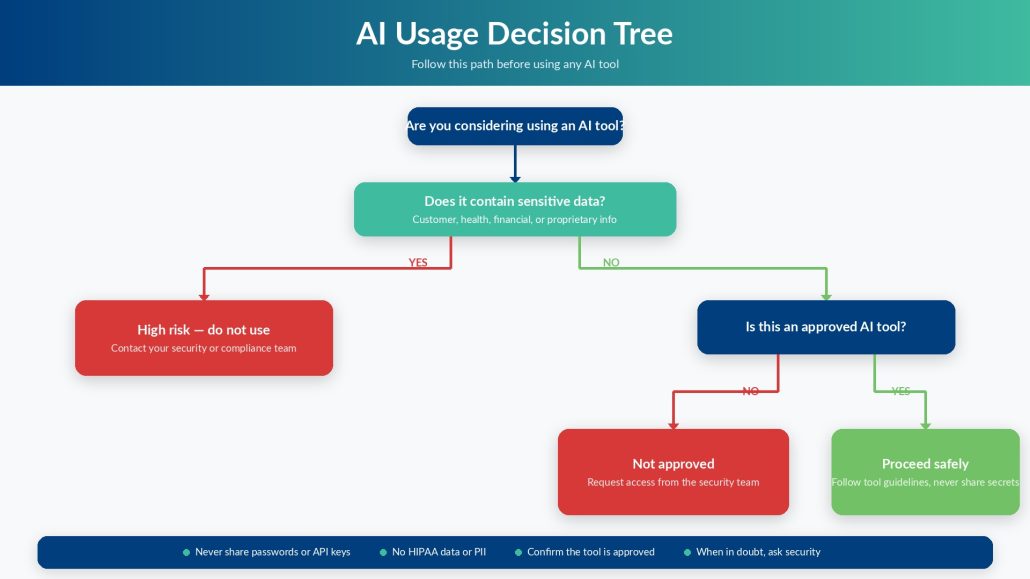
Protecting proprietary data and protected health information (PHI) requires strict, non-negotiable rules against inputting sensitive information into public AI models. Implementing data loss prevention tools like ZScaler and identity controls through Okta ensures that corporate data remains secure and compliant with HIPAA and GDPR.
AI models are inherently data-hungry; they continuously ingest information to train and improve their outputs. If your employees input proprietary information into public AI tools, that data may become accessible to external users.
Defining Permitted vs. Prohibited Uses
Your policy must clearly delineate what is acceptable and what is strictly forbidden.
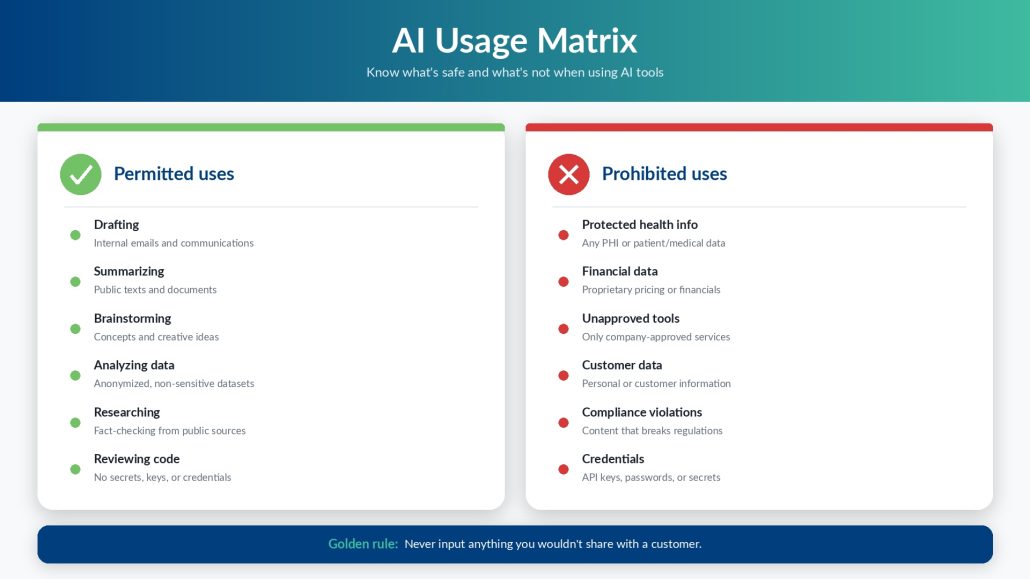
For example, Jordan, a senior analyst, might use an approved generative AI tool to brainstorm marketing concepts. However, Jordan must never upload proprietary client pricing models or sensitive health data into a public tool.
To enforce these boundaries, organizations can leverage advanced security solutions:
- Deploy ZScaler to monitor and block the transmission of sensitive data to unsanctioned public AI websites.
- Utilize Okta to manage secure, role-based access control (RBAC), ensuring only authorized personnel can access specific corporate AI environments.
Defining Roles, Responsibilities, and AI Governance Committees
BLUF (Bottom Line Up Front): Successful AI governance requires a cross-functional steering committee comprising executive leadership, legal counsel, HR, and technical leads. This team oversees strategic implementation, manages vendor vetting, and ensures that human oversight remains central to every stage of the AI tool lifecycle.
AI adoption is not solely an IT concern; it impacts every department within an organization. To ensure broad alignment and successful adoption, establish a cross-functional AI steering committee.
- Executive Leadership: Responsible for strategic oversight and ultimate accountability.
- Legal and Compliance Leads: Track evolving regional and international regulations (such as HIPAA, GDPR, or state-specific privacy laws) and align the policy accordingly.
- Technical Leads: Implement technical safeguards, manage integrations, and conduct regular model validation reviews.
- Human Resources: Integrates AI policies with existing disciplinary frameworks and acceptable use policies.
This committee is also responsible for vendor vetting. When partnering with software-as-a-service (SaaS) providers, the committee must ask how those vendors utilize AI within their platforms and where your data is stored.
Security, Training, and Continuous Policy Monitoring
BLUF (Bottom Line Up Front): Securing AI systems requires a defense-in-depth strategy, including multi-factor authentication (MFA) and continuous endpoint monitoring via SentinelOne. Coupled with Knowbe4 training, employees learn to recognize AI-driven threats, report incidents easily, and adapt to policy updates through bi-annual reviews.
A policy is only as effective as its enforcement and the training that supports it. To protect your digital perimeter, deploy a layered security architecture:
- Enforce strict endpoint security using SentinelOne or CrowdStrike to detect unauthorized AI tool installations or suspicious data transfers.
- Implement continuous security awareness training through Knowbe4 to educate employees on the risks of social engineering, phishing, and data exposure associated with AI.
Because the AI landscape evolves rapidly, an annual policy review is no longer sufficient. We recommend reviewing and updating your corporate AI policy at least twice a year, or whenever major technological shifts occur within your operational environment.
Next Steps: Download Your Free AI Use Policy Template
BLUF (Bottom Line Up Front): Ready to implement these guardrails in your organization? Download our comprehensive, customizable AI Use Policy Template today to define your company’s risk appetite, establish clear rules, and empower your team to innovate safely.
Building an AI policy from scratch can feel overwhelming, but you do not have to do it alone. CIT has developed a customizable, comprehensive AI Use Policy Template designed specifically for businesses looking to establish safe, compliant, and productive AI guardrails.