How To Build Business Apps with AI
What is Vibe Coding and Agentic AI?
Agentic AI represents a paradigm shift from basic conversational chatbots to autonomous task execution systems. This technology enables non-technical business leaders to build fully functional software prototypes simply by describing their operational requirements in plain, natural language—a process widely known as “vibe coding.”
Historically, utilizing artificial intelligence in the workplace meant copying and pasting text into a chatbot to generate ideas, draft emails, or analyze small datasets. In 2026, the landscape has evolved into the agentic era. Tools like Anthropic’s Claude Desktop, OpenAI’s GPT Work, and Microsoft Copilot are no longer just passive advisors; they are active creators.
These agentic systems can autonomously organize directory structures, generate clean codebase files, build interactive dashboards, and update cloud-hosted files. For project managers, senior analysts, and content marketers, this means the barrier to software creation has officially collapsed. You can now take a conceptual workflow bottleneck and turn it into a visual, interactive application in minutes without touching a terminal.
The Workflow: From “Vibe” to Clickable Prototype
Creating a successful AI-assisted application requires a structured workflow that translates business needs into clear specifications. By utilizing interactive AI design platforms, managers can quickly generate clickable prototypes, test edge cases, and gather real-world user feedback before writing production code.
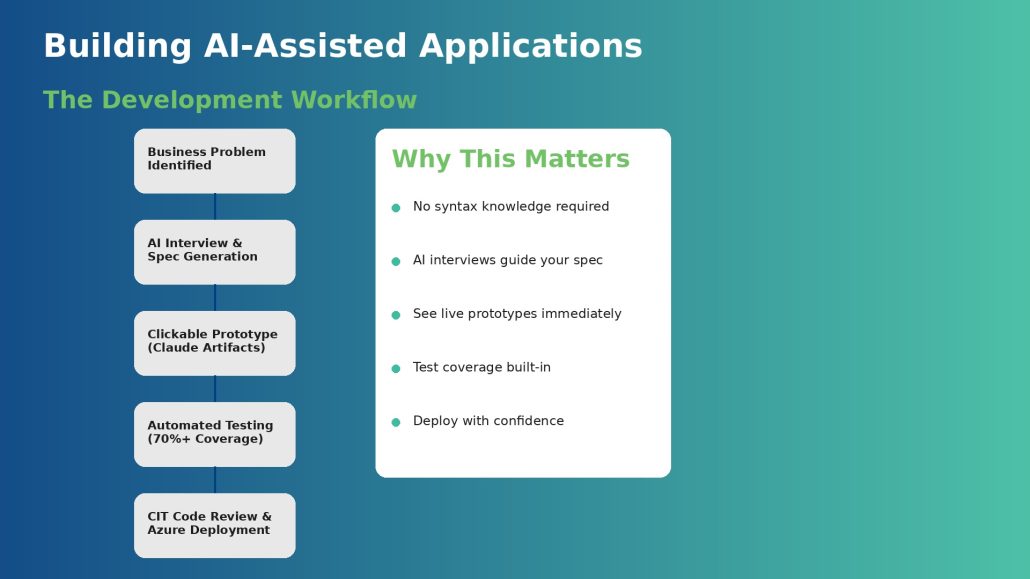
To build a functional application with AI, you do not need to know syntax, but you do need a logical plan. The development process typically follows these structured stages:
- Building the Brief: Instead of guessing what to build, advanced models now interview you directly. Furthermore, platforms like Claude Design prompt you to define the target user. Additionally, they help you clarify the core problem. Most importantly, they guide you to articulate what success looks like.
- Prototype Generation: Once you’ve defined your brief, the AI processes your answers. Subsequently, it generates a “live artifact”—a clickable, visual prototype. For example, during a recent CIT Solutions session, our team built two distinct apps. Specifically, they created an interactive client conversation rehearsal tool for account managers. They also built a shared resource reservation dashboard. Notably, both were demonstrated in real-time.
- Automated Testing: As your application evolves, you need protection against breaking changes. Therefore, you can instruct the AI to write comprehensive test suites. In particular, enforcing rules like “maintain 70% code coverage” works well. Consequently, the AI automatically generates and runs tests. Moreover, it does this for every new feature you request.
Bridging the Gap Between Prototyping and Production Security
While AI-assisted coding tools excel at rapid prototyping, transitioning an application to an enterprise-grade production environment requires professional developer oversight, rigorous code reviews, and secure hosting on compliant cloud platforms like Microsoft Azure.
While “vibe coding” is an incredible enabler for proof-of-concept designs, there is a distinct boundary between a prototype and a secure business tool. AI models are optimized to give confident answers, but they can occasionally generate insecure code or “AI slop”—redundant, unoptimized scripts that create severe performance bottlenecks.
To safely transition a prototype into an operational business tool, human verification is essential. A seasoned developer must review the AI-generated code to ensure it aligns with your organization’s supported technology stack. Furthermore, the application must be deployed within a secure, high-availability hosting environment.
By containerizing these applications and hosting them on Microsoft Azure, businesses gain peace of mind. This infrastructure ensures your custom-built applications inherit robust security baselines, guaranteed uptime, and compliance with strict regulatory frameworks. For added identity security and access control, integrating tools like Okta ensures only authorized team members can access your new digital assets.
Guardrails and Governance: What to Avoid Without IT Sign-Off
To prevent data leakage and compliance violations, organizations must establish strict AI governance policies. Non-technical users should never connect experimental AI applications to live databases, customer data, or public URLs without prior IT security vetting.
The ease of AI app development introduces new security risks. If an employee builds an autonomous agent with excessive system permissions, a single coding error could accidentally delete operational data or expose proprietary information.
To safely navigate this rapid technology adoption, organizations must implement clear guardrails:
- No Personal Accounts: Employees must never use personal AI subscriptions for business tasks. Enterprise-grade business subscriptions for Anthropic Claude or OpenAI GPT Work are required to ensure your data is protected under SOC 2, HIPAA, and corporate privacy policies.
- Isolate Sensitive Data: Do not feed live customer databases or protected health information (PHI) into experimental prototyping tools.
- Vetted Integrations: Before connecting an AI app to external APIs or live systems, consult with cybersecurity experts. Implementing endpoint security and threat prevention tools from partners like CrowdStrike, SentinelOne, and Threatlocker ensures your environment remains secure against unauthorized data transfers.
How to Get Started: Empowering Your Internal Champions
Successful AI adoption begins by identifying manual, repetitive bottlenecks, equipping a select group of internal champions with enterprise-grade AI tools, and scaling structured training programs safely across the wider organization.
The best way to start is by inventorying the tasks your team dislikes doing—such as manual report generation, data shifting, or repetitive scheduling. Use these bottlenecks as the initial use cases for your AI-assisted applications.
Frame your development ideas as a proposal for collaboration with your IT department rather than a request for permission. By showing IT a visual, clickable prototype built in a secure sandbox, you make it incredibly easy for them to help you deploy it safely.
Are you ready to unlock the power of agentic AI and build custom solutions for your team? CIT Solutions is here to help you design the policies, select the right platforms, and provide the technical oversight needed to turn your ideas into secure, scalable business tools.